




Human Rights
3
 min read

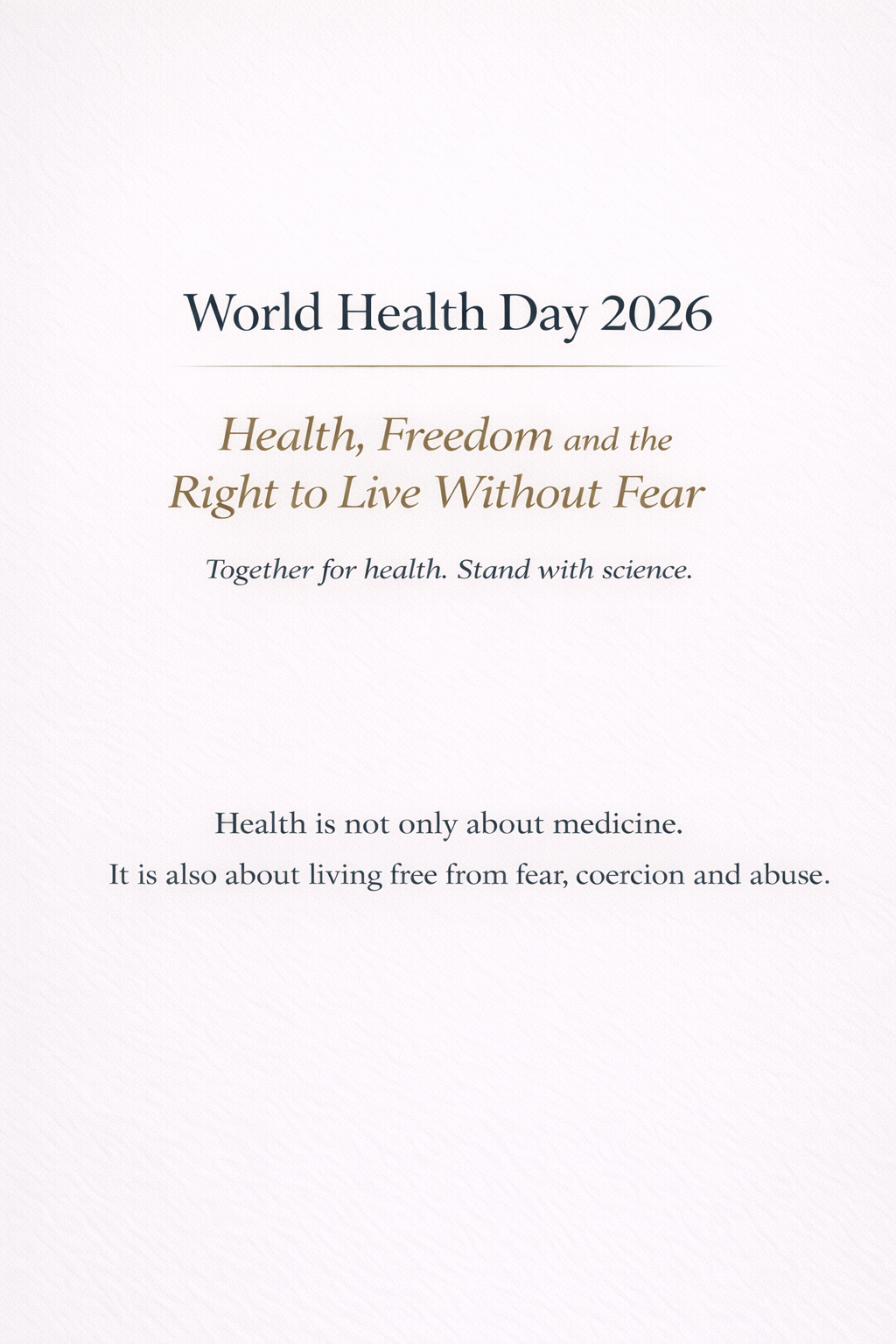
World Health Day 2026: Health, Freedom and the Right to Live Without Fear

The World Health Organisation has marked World Health Day 2026 under the theme “Together for health. Stand with science.” It is a timely message. But health is not only about medicine. It is also about whether people can live safely, speak freely and make choices without fear.

Written by

Aneeta Prem

Published on

April 7, 2026

Today is World Health Day 2026, and the World Health Organisation has chosen a theme that should make governments and communities think harder: “Together for health. Stand with science.” WHO says the day begins a year-long campaign focused on scientific collaboration, evidence-based action and the One Health approach. That is important. But it is only part of the picture. A society does not become healthy simply because it values medicine. It becomes healthier when people are able to live without coercion, intimidation or violence.

That matters because health is too often discussed as though it begins in a clinic. It does not. It begins in the home, in the family, in the school, in the street, and in the unspoken rules that shape whether someone can say no without punishment. A girl being pressured into marriage is not safe. A young woman living under control is not free. A person who is frightened to refuse does not enjoy good health in any meaningful sense, however normal life may appear from the outside.

In the UK, the legal and safeguarding position is clear. Forced marriage is illegal. Government guidance states that it is a form of domestic abuse and a serious abuse of human rights. It defines forced marriage as a marriage where one or both people do not or cannot consent and pressure or abuse is used. It also states that making someone marry before the age of 18 is forced marriage, even if no pressure or abuse can be proved.

Those points matter well beyond the law. They tell us something larger about health itself. When choice is stripped away, the damage is not only legal or social. It is personal, bodily and often long-lasting. Fear settles into daily life. Confidence narrows. Trust is broken. The future becomes something managed by others. That is why I resist tidy definitions of health that leave out power, coercion and consent. They are too small for the world people actually live in.

The WHO theme this year asks us to stand with science. We should. Yet science is not only about discovery. It is also about accepting what evidence shows us and acting on it. If evidence tells us that coercion and chronic fear damage wellbeing, then health policy cannot sit in one room while safeguarding sits in another. The two belong together. That is not ideology. It is a practical reading of how harm works.

For me, this is not a theoretical point dressed up for an awareness day. Much of my work has involved listening to what happens when fear is normalised and silence is mistaken for agreement. Coercion is often hidden behind words such as family, duty, culture, reputation or shame. It thrives when adults hesitate, minimise risk or tell themselves it is none of their business. By the time a case becomes obvious, the harm is usually already deep.

That is why prevention matters. Schools need the confidence to talk plainly. Professionals need to recognise the signs early. Police, teachers, health workers and safeguarding leads need to understand that silence does not mean consent. Families and communities need to hear a message that is simple and non-negotiable: tradition does not excuse abuse. The statutory guidance says forced marriage should form part of existing child and adult protection structures. It is not a private matter to be brushed aside.

World Health Day is often used to speak about disease, treatment and public systems. All of that matters. But the day should also ask a harder question: what kind of life are we protecting? If someone cannot choose freely, cannot refuse safely and cannot live without fear of being controlled, there is something hollow about congratulating ourselves on being a healthy society.

So on World Health Day 2026, my argument is a simple one. Health must mean more than access to treatment. It must include safety. It must include bodily autonomy. It must include consent. It must include the right to live without fear. WHO is right to tell the world to stand with science. In Britain, standing with science should also mean standing firmly with those whose lives are constrained by coercion and abuse.

Health means more than survival. It means freedom.

www.freedomcharity.org.uk

Aneeta Prem
London
7 April 2026

Contact me

Get in touch

I'd love to hear from you.
Thank you! Your submission has been received!
Oops! Something went wrong while submitting the form.
Latest posts

News Articles

Tips, guides, useful information, and the latest news.

Human Rights
3
 min read

When abuse kills without the final blow

Lee Milne's sentencing in Scotland is a legal milestone. More importantly, it forces the law and the public to face a truth survivors have long understood: coercive control can be fatal, even where the perpetrator did not physically commit the final act.

Read post
3
 min read

Forced marriage UK law: why the system still fails victims

The UK now describes forced marriage, FGM and so-called honour-based abuse more accurately than before. But the law still struggles to prosecute how these crimes often happen in real life: through family pressure, community enforcement, fear, shame and collective control.

Read post
Human Rights
3
 min read

World Health Day 2026: Health, Freedom and the Right to Live Without Fear

The World Health Organisation has marked World Health Day 2026 under the theme “Together for health. Stand with science.” It is a timely message. But health is not only about medicine. It is also about whether people can live safely, speak freely and make choices without fear.

Read post
Human Rights
3
 min read

FGM prosecutions are still rare: why schools matter more than ever

The March 2026 safeguarding update makes one thing harder to deny: forced marriage and FGM belong inside mainstream child protection. The question now is whether institutions can act early enough to prevent harm.

Read post
Human Rights
3
 min read

Noelia Castillo and the failure that came first

Noelia Castillo Ramos died in Barcelona on 26 March 2026 after a long legal battle over her right to euthanasia. Her death will reignite debate over assisted dying. The deeper human rights question is what failed her long before the final decision.

Read post
Human Rights
3
 min read

FGM reconstruction surgery UK | Britain still has no proper NHS pathway

Female genital mutilation reconstruction UK, NHS pathway for FGM survivors, clitoral reconstruction UK, FGM survivor care UK, Women and Equalities Committee FGM reconstruction

Read post