





Human Rights
6
 min read

Capacity, Consent and Dishonour Abuse

Capacity, Consent and Dishonour Abuse: Why “no capacity means no consent” is the safeguard the world is still failing to apply

Written by

Aneeta Prem

Published on

January 2, 2026

Capacity, Consent and Dishonour Abuse

Why “no capacity means no consent” is the safeguard the world is still failing to apply

By Aneeta Prem MBE JP
Safeguarding, capacity and dishonour abuse expert
Published: [insert date]

Across the world, abuse carried out in the name of family, tradition or control continues to be misinterpreted as consent. This misunderstanding costs lives, freedoms and futures.

Girls are forced into marriage.
Babies are cut before they can speak.
Adolescents are treated as willing when they are terrified.
Disabled adults are married off for care, control or convenience.

In every one of these cases, the same safeguard is missed.

Capacity.

This article explains why capacity matters, why the law is not working in practice, and where the real shortfalls lie. It is written for governments, safeguarding professionals, researchers and victims alike, because the failure is systemic, not individual.

What is dishonour abuse?

Dishonour abuse is a pattern of harm driven by control, compliance and family enforcement. It exists globally, including in the UK and across diaspora communities. It is not confined to any one religion, country or culture.

Dishonour abuse can include:

  • forced marriage and child marriage
  • Female Genital Mutilation (FGM)
  • forced pregnancy or sexual control
  • restrictions on education, healthcare or movement
  • family-enforced violence
  • abuse of disabled or dependent adults framed as “care”
  • surveillance, isolation and coercion

The form varies. The mechanism does not.

Power is exercised over someone who cannot freely refuse.

Capacity: the legal foundation of consent

Capacity is not a technical assessment. It is the legal gateway to consent.

In plain English, a person has capacity to make a decision only if they can:

  • understand the relevant information
  • retain it long enough to decide
  • weigh it as part of the decision-making process
  • communicate a decision in any way

Capacity is decision-specific and time-specific. It is not a judgement about intelligence, obedience, maturity or family agreement.

If a person cannot understand what marriage or a harmful practice actually involves, they cannot consent to it.

Silence does not create consent.
Compliance does not create consent.
Family approval does not create consent.

No capacity means no consent.

This principle underpins safeguarding law in the UK and aligns with international human rights standards.

Children: consent is legally impossible

In cases involving children, capacity should not be debated at all.

A child cannot consent to marriage.
A child cannot consent to FGM.
A child cannot consent to serious harm.

This is not cultural. It is legal.

Safeguarding law does not require a child to object, disclose or resist. The duty is prevention, not interpretation.

Babies and unborn children: the most overlooked victims

Safeguarding systems repeatedly fail babies and very young children.

Risk assessments too often depend on disclosure, physical signs or previous intervention. Babies cannot disclose. By the time physical signs appear, harm has already occurred.

Where:

  • a mother has undergone FGM
  • older siblings have already been harmed
  • forced marriage is known in the family
  • extended family enforce control

a baby girl is automatically at heightened risk.

This is not speculation. It is safeguarding reality.

The law allows early intervention based on risk. Practice often waits for certainty. Babies pay the price for that delay.

Adolescents: mistaken for consenting when they are controlled

Adolescents are frequently misclassified as making free choices.

Professionals may say:

  • “She hasn’t said no.”
  • “She says she agrees.”
  • “She’s nearly 18.”
  • “She seems mature.”

This misunderstands coercion.

In dishonour abuse, adolescents are often groomed into compliance from childhood. They are monitored, emotionally blackmailed, threatened with abandonment, violence or disgrace. Agreement becomes a survival strategy.

Compliance under control is not consent.

When professionals confuse calmness or silence with choice, safeguarding collapses at the moment it is most needed.

Adults, disability and coercion

Capacity failures do not only affect children.

Adults with learning disabilities, cognitive impairment, mental ill-health, neurodivergence, trauma, communication barriers or high dependence on family members face heightened risk.

A critical error occurs when coercion is treated as separate from capacity.

Coercion destroys consent.

Where fear, pressure, surveillance, dependency or deception are present, apparent agreement is legally unreliable. A “yes” given to avoid harm, abandonment or deportation is not free.

Professionals who rely on surface agreement without examining context are not neutral. They are enabling abuse.

Marriage used as a tool of exploitation

One of the most serious and least acknowledged safeguarding failures is marriage being used to secure care.

Families arrange marriages for sons with significant learning disabilities or mental illness, not to create an equal adult partnership, but to guarantee a full-time carer.

The woman is often not told the truth.

She may be brought from overseas.
She may be told the man is “quiet” or “needs support”.
The reality is concealed until she is trapped.

Once married, she is expected to provide round-the-clock care, alongside sexual access, domestic labour and isolation. Immigration dependency is used to prevent escape. Threats, shame and blackmail replace choice.

This is not marriage. It is exploitation. In many cases, it meets indicators of modern slavery.

Capacity matters on both sides.
Deception invalidates consent.
Lack of capacity invalidates consent.

When this is ignored, safeguarding legitimises abuse.

Why capacity was written into forced marriage law

When forced marriage law was developed in the UK, capacity was deliberately embedded. This was fought for because practitioners knew forced marriage does not only occur where someone says “no”.

It also occurs where a person cannot consent at all.

Without capacity provisions, the law would have protected only those able to articulate refusal, not the most vulnerable: children, disabled people and those under overwhelming control.

The intention was clear.

A marriage is forced where:

  • a person lacks capacity to consent, or
  • consent is obtained through coercion, pressure or deception.

Silence was never meant to be treated as consent.
Apparent agreement was never meant to override incapacity.

This was the safeguard. It remains the safeguard.

Legal clarity: how forced marriage law treats capacity

UK forced marriage law recognises that forced marriage is not limited to situations where someone verbally refuses.

In law, a marriage is forced where free and full consent is absent. That absence can arise because:

  • consent is obtained through coercion, pressure or deception, or
  • a person lacks the capacity to consent at all.

This framework was deliberately designed to protect children, disabled people and those under overwhelming family control, even where no explicit refusal is made.

In practice, this means:

  • silence does not equal consent
  • apparent agreement does not override incapacity
  • family approval has no legal weight
  • professionals do not need to wait for harm to occur before acting

Where a person lacks capacity, consent is legally impossible.
Where consent is impossible, the marriage is forced in law.

This was the safeguard Parliament intended.

How practice has drifted from the law

Despite clear legal intent, practice has narrowed.

Capacity is too often treated as:

  • a secondary issue
  • something to assess only if concerns are obvious
  • or something to revisit after harm

This was never the purpose of the law.

Capacity was designed as an early warning system, not a retrospective explanation.

When professionals wait for disclosure, resistance or visible distress, they are no longer applying the law as written. They are diluting it.

Why the law is not working in practice

The failure is systemic and predictable.

Disclosure culture
Professionals wait for victims to speak. Babies cannot. Children often cannot. Coerced adults may not dare.

Cultural hesitation
Fear of being seen as insensitive leads to delay. Safeguarding law does not permit neutrality where harm is suspected.

Fragmented systems
Health, education, social care, police and immigration act separately. Dishonour abuse does not fit neatly into one service.

Late use of protection powers
Courts have strong tools to prevent harm, but they are often used after abuse has occurred, not before.

Misreading silence as safety
Lack of disclosure is treated as reassurance. In safeguarding law, it is often the opposite.

This is not a loophole in law. It is a failure of application.

Why dishonour abuse is under-reported and under-counted

Research and official data significantly understate the scale of forced marriage, FGM and wider dishonour abuse. This is not because the problem is small, but because much of the harm is structurally invisible.

Key reasons include:

Silence is misread as absence
Babies cannot disclose. Children may lack language or safety. Adolescents may comply to survive. Disabled adults may communicate through perpetrators.

Harm occurs outside reporting systems
Abuse frequently takes place overseas during family travel, where evidence is lost and safeguarding oversight is absent.

Cases sit in the wrong data sets
Many victims are recorded under immigration, domestic abuse, mental health or disability services rather than as forced marriage or FGM cases.

Fear suppresses reporting
Victims may fear retaliation, destitution, immigration consequences or total isolation if they speak.

Prevention is not measured
Early intervention that successfully stops harm is rarely recorded, creating the false impression that risk was low.

Absence of data is often misread as absence of harm. For safeguarding and research purposes, this is a serious analytical error.

Dishonour abuse is not rare. It is hidden.

Why language matters

The term “honour-based abuse” is widely used. I use dishonour abuse deliberately.

There is no honour in:

  • forcing a child into marriage
  • cutting a girl’s body
  • trapping someone through fear or dependency

The dishonour lies with the perpetrator, not the victim.

Language shapes judgement. When abuse is softened, safeguarding weakens. When it is named clearly, action follows.

Capacity as the global safeguarding red line

Across countries, cultures and legal systems, one principle holds.

Where a person lacks capacity or freedom, consent is invalid.

Treating capacity as non-negotiable does three things:

  1. removes ambiguity
  2. triggers early protection
  3. prevents irreversible harm

Capacity and consent are not Western ideas. They are human safeguards.

What must change now

To protect babies, children, adolescents and vulnerable adults:

  • risk must be enough to act
  • silence must be recognised as a warning sign
  • coercion must never be mistaken for consent
  • cultural explanations must not override legal duty
  • capacity must be assessed early and properly
  • prevention must be prioritised over reaction

The law already allows this. Practice must catch up.

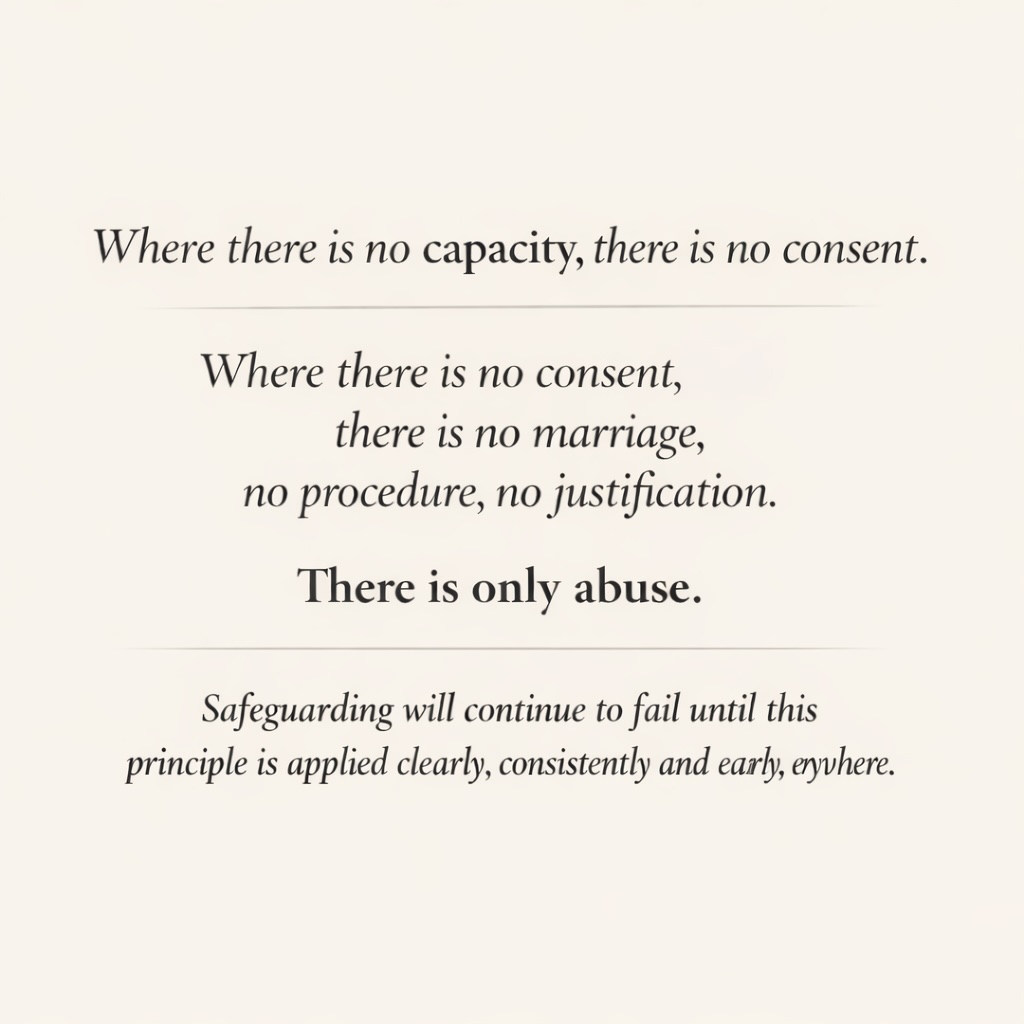
Where there is no capacity, there is no consent.
Where there is no consent, there is no marriage, no procedure, no justification.
There is only abuse.

Safeguarding will continue to fail until this principle is applied clearly, consistently and early, everywhere.

About the author

Aneeta Prem MBE JP is an internationally recognised expert on safeguarding, capacity and dishonour abuse. She is the Founder of Freedom Charity and has advised and trained professionals across policing, health, education, government and the judiciary in the UK and internationally.

Contact me

Get in touch

I'd love to hear from you.
Thank you! Your submission has been received!
Oops! Something went wrong while submitting the form.
Latest posts

News Articles

Tips, guides, useful information, and the latest news.

Human Rights
5
 min read

Gambia FGM court case

The Gambia’s Supreme Court is hearing a case that could weaken the ban on FGM. This clear explainer shows why it matters for child protection worldwide.

Read post
Human Rights
5
 min read

Stalking is not love: the law, the danger, and dishonour abuse

When families watch, follow and report: the hidden stalking dynamic behind forced marriage and dishonour abuse

Read post
Human Rights
3
 min read

AI nudification, dishonour abuse, and why children must be protected now

How AI nudification is turning everyday photos into a new form of sexual abuse against children Two strong alternatives, depending on outlet tone: How AI nudification apps are normalising sexual abuse and putting children at risk

Read post
Human Rights
6
 min read

Capacity, Consent and Dishonour Abuse

Capacity, Consent and Dishonour Abuse: Why “no capacity means no consent” is the safeguard the world is still failing to apply

Read post
6
 min read

Female genital mutilation in the UK

Female genital mutilation in the UK: what we don’t say out loud. Female genital mutilation is not “a problem elsewhere”. It is child abuse happening in the UK and worldwide, and girls need us to name it.

Read post
Human Rights
3
 min read

Balochistan Child Marriages Restraint Act 2025

Balochistan Child Marriages Restraint Act 2025 Provincial law: minimum marriage age 18. Cognisable, non-bailable, non-compoundable offences. Forced marriage is child abuse. The shame lies with the perpetrator, not the child.

Read post