






Published: 22 February 2026
Location: London, United Kingdom
By Aneeta Prem MBE
A young man identified in Indian media as Gurpreet Singh was shot dead at his home in Punjab, India, in a killing police linked to opposition to his love marriage, with arrests reported in Indian media. Some coverage has described the case as an “honour killing”. That wording misleads. It risks echoing the perpetrator’s rationale instead of naming the crime plainly: murder.
This is also why the UK’s current debate about “honour-based” language matters. When public bodies adopt language that reflects the abuser’s framing, clarity can slip at the exact moment it is most needed.
According to The Times of India, Sangrur police said Gurpreet Singh, also reported as “Babbu”, was shot dead at his house in Lehal Kalan village on the night of 17–18 February. The same report states that police arrested four men within hours and recovered firearms, ammunition and a vehicle allegedly linked to the attack.
Hindustan Times separately reported that police arrested a man accused of plotting his brother-in-law’s murder in connection with his sister’s marriage against the family’s wishes.
Investigations are ongoing. Courts will determine charges and guilt. However, the central point in the public reporting is clear: the alleged motive relates to opposition to a relationship and marriage chosen by the victim.
This case has been described through the language of “honour”. Yet what the reporting shows is not honour in any meaningful sense. It is control, enforced within one family.
In cases like this, “honour” often operates as internal enforcement. Families punish a person for disobedience and attempt to reassert authority over personal choice. That is why framing matters. When murder is treated as a cultural dispute or a clash between families, responsibility can blur. When it is recognised as intra-family coercion, risk factors become clearer.
What occurred here was coercive control escalating to murder.
Where perpetrators claim to act for “honour”, that claim should never soften the crime. It aggravates it.
Invoking honour can indicate intent, planning and group enforcement. Those features align with premeditation, not mitigation. The violence reported here was brutal, premeditated and criminal.
The victim’s name should not be linked to any family’s asserted honour. He exercised personal choice. The killing, as reported, was a punishment for that choice.
Calling such killings “honour-based” risks importing the perpetrator’s rationale into the description of the offence. The correct framing is murder, with claimed honour treated only as part of the alleged motive and aggravation.
This killing comes as the House of Lords debates the language used in law, policy and safeguarding to describe violence framed as “honour-based”.
Language is not a side issue. Words shape professional judgement. When public bodies repeat honour language, even unintentionally, they risk echoing the same logic used to justify coercion and punishment.
The Punjab case shows why clarity matters. A man was killed because he chose his partner. There is no honour in that. There is only violence used to enforce obedience.
If the UK wants earlier safeguarding action, the system must name the harm clearly and refuse language that dignifies it.
Killings linked to “honour” claims sit within a broader pattern that includes forced marriage, coercive control and family-based threats. These crimes often depend on silence, isolation and pressure long before physical harm occurs.
Clear language supports earlier intervention because it centres harm, sharpens accountability and helps professionals recognise coercion as a safeguarding indicator. Euphemistic language delays decisions. It also makes it harder for those at risk to describe what is happening to them.
If you want background reading on UK safeguarding practice, see:
This was not an honour killing. It was a murder framed by others as honour.
Public reporting describes a man shot dead after a love marriage opposed by family members, with police action and arrests under way.
A justice system should never allow language to dignify brutality. Where “honour” is claimed, it should be treated only as evidence of intent and aggravation, never as context that softens the crime.
“There is no honour in murder. When control is enforced through violence, the duty of the justice system is to name the harm clearly and treat claimed honour only as an aggravating factor, never as context.”
Aneeta Prem MBE

FGM prevention matters, but survivor care must not be the unfinished part of UK policy. Aneeta Prem calls for a clear NHS pathway, specialist counselling, trained professionals and research into reconstructive surgery.

Many children are not choosing the best place to spend their time. They are choosing the safest unsafe place available.
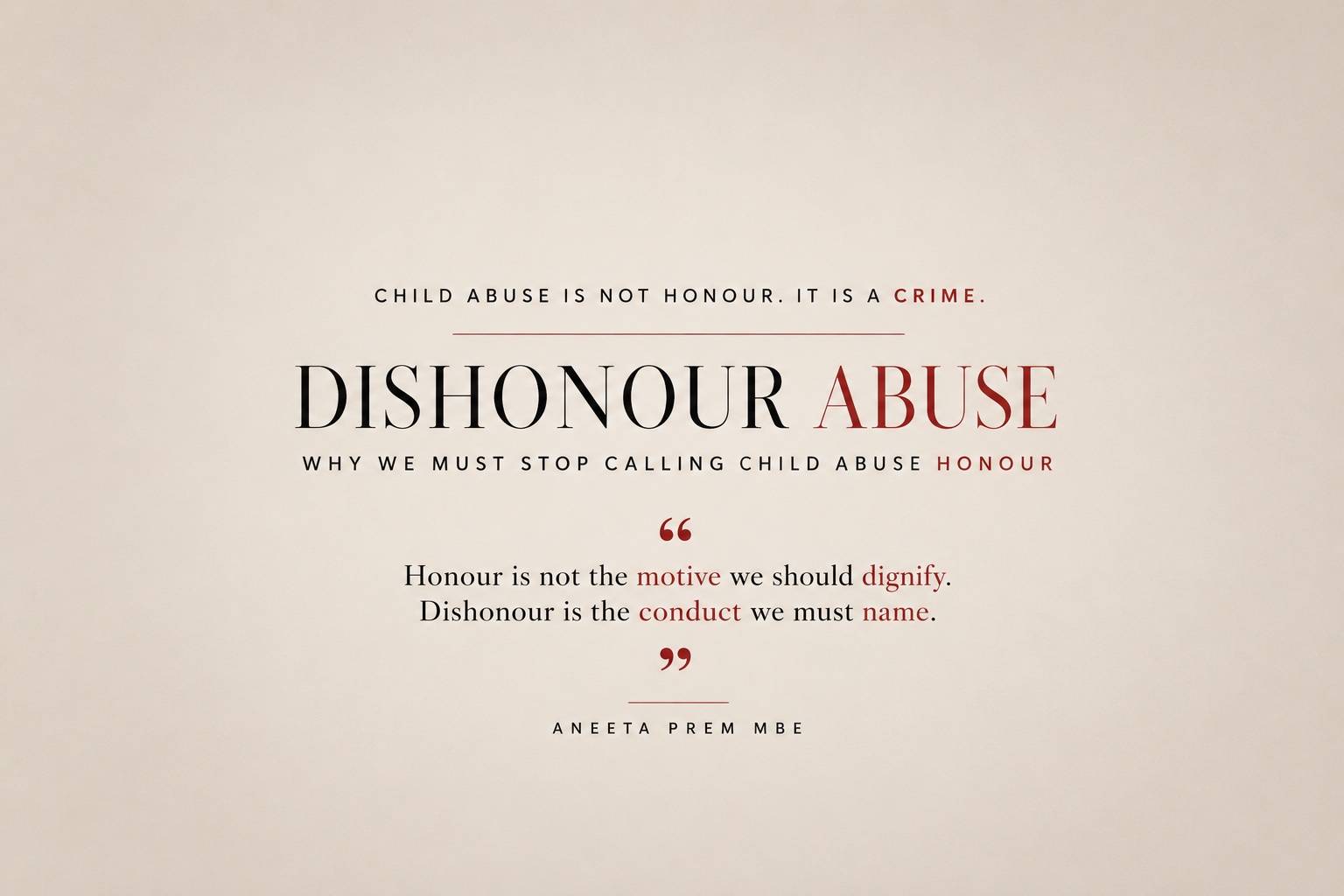
Dishonour Abuse is abuse, coercion or violence justified through claims of family reputation, shame or so-called honour. I use the term because “honour-based abuse” repeats the perpetrator’s excuse, while Dishonour Abuse names the conduct and places responsibility where it belongs: with the person causing harm, not the victim, child or survivor.

The murder of Henry Nowak raises difficult questions about policing, evidence and the duty to preserve life

The death of Twisha Sharma has reopened a global question about dowry abuse, coercive control, family reputation and why women are still judged by what their families can provide.

Afghanistan's child marriage is worsening as hunger, aid cuts and Taliban family law place girls at risk. Aneeta Prem writes on why silence is not consent.