




Reviewed and updated 22 August 2026.
By Aneeta Prem MBE
Afghanistan’s Taliban authorities have used law and regulation to narrow women’s freedom across education, work, movement and family life. Decree No. 12 adds another disturbing example: a penal framework that gives an extremely weak legal response to serious violence against women.
The most defensible criticism is already severe enough. It does not need the viral claim that the decree simply says a husband may beat his wife as long as no injury is visible.
What Decree No. 12 is
Decree No. 12 is a penal regulation issued by Afghanistan’s de facto Taliban authorities in 2026.
International reporting and United Nations analysis describe a code that entrenches unequal treatment and sharply limits protection for women.
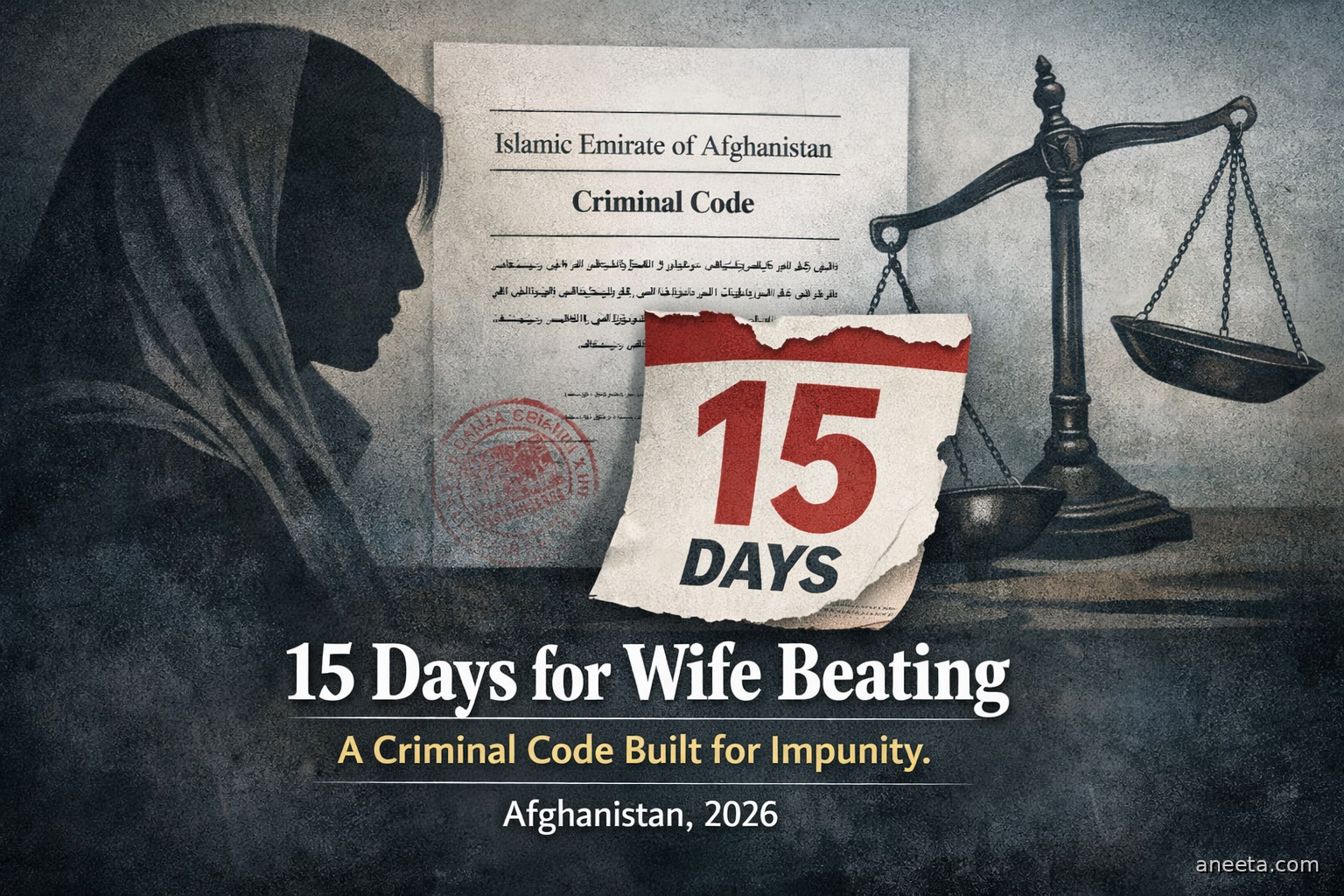
Associated Press reporting on the regulation identified a penalty of only 15 days’ imprisonment where a man visibly injures his wife. UNAMA later described Decree No. 12 as allowing only limited judicial intervention where women are severely beaten, with a 15-day prison sentence for husbands convicted of serious abuse.
That is an extraordinarily weak response to domestic violence.
What the decree does not safely support saying
One widely repeated formulation claims that the Taliban expressly made wife beating lawful provided there is “no visible injury”.
I would not present that as a direct legal quotation unless the precise provision and authoritative translation can be produced.
The evidence we do have is enough: the legal framework provides very limited protection and a strikingly low penalty even where serious violence is recognised.
Accuracy matters especially where the underlying policy is already indefensible.
Why a 15-day penalty matters
Domestic abuse is rarely understood properly if each assault is treated in isolation.
It can involve intimidation, coercive control, financial dependence, threats, isolation, forced sex, restrictions on movement and repeated violence.
A legal system that responds to severe abuse with a token penalty sends a message about whose safety carries weight.
It also affects whether a victim believes reporting will make her safer or expose her to further retaliation with little meaningful protection.
This does not sit in isolation
Decree No. 12 forms part of a much wider restriction of women’s rights under Taliban rule.
Girls remain excluded from secondary education. Women’s access to higher education, many forms of work and public life has been severely curtailed. Independent legal and institutional protections available before the Taliban takeover have also been dismantled or weakened.
Domestic violence therefore has to be understood inside a system where many of the routes a woman might use to leave, earn money, obtain independent advice or rebuild her life are themselves restricted.
This is a governance issue, not a cultural excuse
It is too easy to describe violence against women in Afghanistan as “culture”.
Decree No. 12 is not culture. It is governance. It is a set of rules issued by people exercising state power.
Afghan women and men are not a single bloc, and many have resisted restrictions on women’s rights at enormous personal risk.
Criticism should therefore be directed at the authorities and the legal framework, not lazily attributed to an entire population, religion or ethnicity.
Why international legal standards still matter
The fact that the Taliban authorities control Afghanistan does not remove international human-rights standards concerning violence against women, equality, bodily integrity and access to justice.
United Nations bodies have repeatedly warned that the cumulative restrictions imposed on Afghan women and girls amount to systematic discrimination and have raised wider concerns about gender persecution.
Those standards also matter for governments making asylum, protection and diplomatic decisions involving Afghan women and girls.
What professionals outside Afghanistan should understand
For UK safeguarding and asylum practice, the legal environment in Afghanistan can be highly relevant to risk.
A woman or girl facing forced marriage, domestic abuse or family violence may have far fewer realistic protection routes if returned to a system where women’s autonomy and access to justice are severely constrained.
Individual cases still require individual assessment. Country conditions should inform that assessment rather than replace it.
Final word
Decree No. 12 does not need to be exaggerated to be condemned.
A legal framework that provides only a 15-day penalty in serious wife-beating cases, within a system already stripping women of education, work and public autonomy, represents a profound failure of protection.
The issue is not whether a viral slogan is perfectly worded. The issue is that the law itself treats serious violence against women with shocking weakness.
Sources and further reading
- Associated Press: Afghanistan’s Decree No. 12 and domestic-violence penalties
- UNAMA: May 2026 statement placing Decree No. 12 in the wider legal context
- UNAMA: women’s access to formal justice, 8 March 2026