





Reviewed and updated 20 August 2026 against current United Nations, UNESCO and UNICEF evidence.
By Aneeta Prem MBE
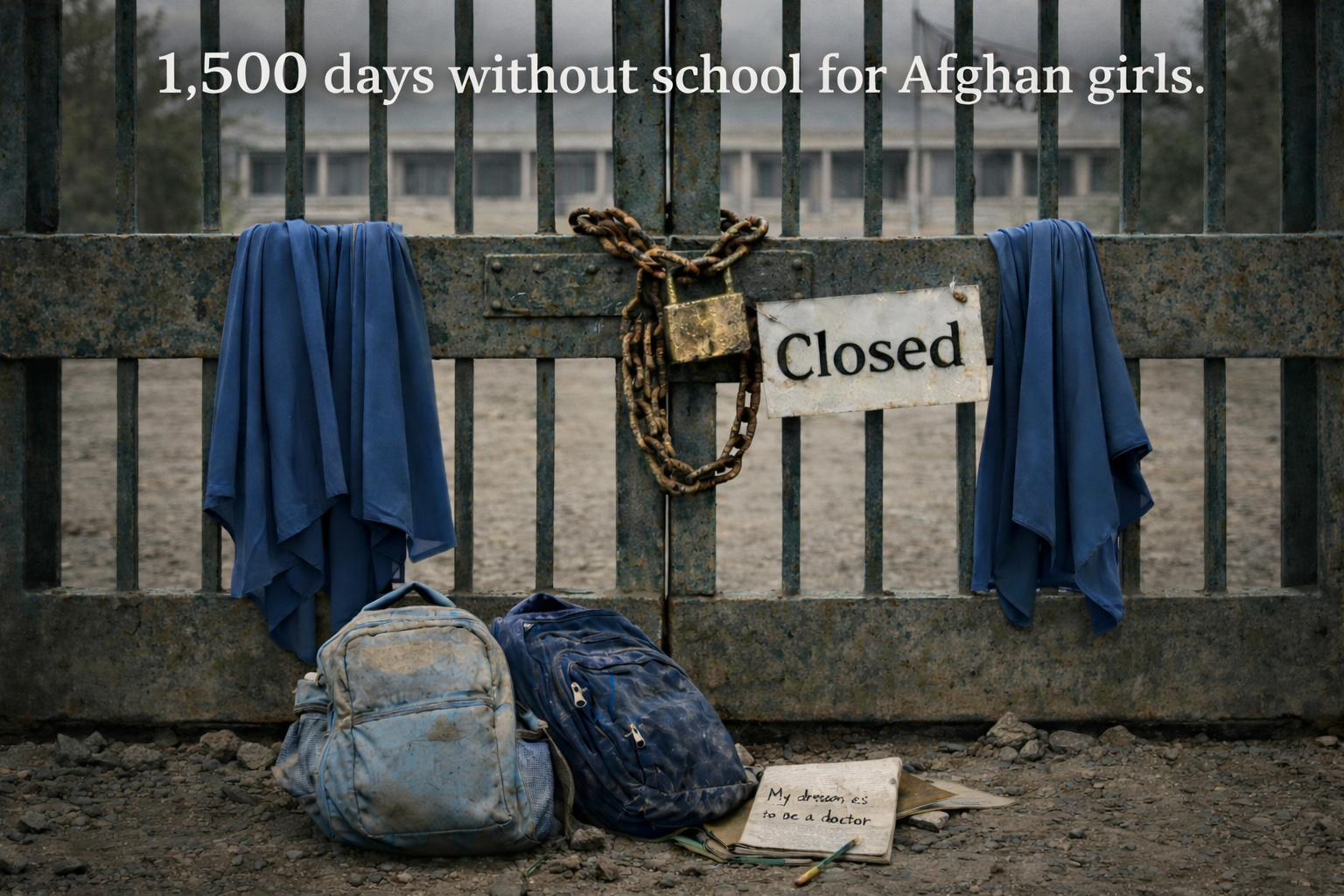
Afghanistan remains the only country in the world where girls and women are formally barred from secondary and higher education.
The scale of that exclusion is still growing.
In January 2026, UNESCO and UNICEF reported that 2.2 million adolescent girls had been banned from attending secondary school. By June, a United Nations briefing to the Security Council estimated that more than 2.6 million adolescent girls were out of school and that approximately 250,000 more girls each year were being permanently excluded from secondary-education pathways.
Those figures are not simply education statistics. Removing girls from school changes their future health, income, independence, visibility and ability to make choices about marriage and family life.
Education is a safeguarding structure
School provides more than lessons.
It gives children routine contact with adults outside the family. Teachers may notice absence, fear, sudden changes in behaviour, injuries, withdrawal or unexplained plans to leave education.
Where a girl is removed from secondary education by national policy, that protective structure is weakened at enormous scale.
This does not mean school attendance prevents every form of abuse. It means education is one of the places where children develop independence, information, relationships and routes to help.
The ban now affects more than 2.6 million adolescent girls
A June 2026 United Nations briefing estimated that 3.8 million girls aged 7 to 18 were not in school, including more than 2.6 million adolescent girls.
The United Nations said the restrictions were creating long-term generational harm and warned that each year around 250,000 more girls were being permanently excluded from secondary-education pathways.
That is why a headline written around a fixed number of days quickly becomes obsolete. The more important fact is structural: each new school year adds another group of girls who are allowed to complete primary education but are then stopped from continuing.
The effects reach beyond the classroom
UN agencies have warned that the education restrictions are already affecting Afghanistan’s economy and future workforce.
The consequences also reach health services. A country that prevents girls progressing through secondary and higher education restricts the future supply of female teachers, doctors, nurses, midwives and other skilled professionals.
That matters especially where women’s access to male professionals may itself be restricted.
Education therefore affects not only the girl who is excluded today but the services available to women and children tomorrow.
Education and child-marriage risk are connected
UNICEF has explicitly linked the continuing exclusion of girls from education with a higher risk of child marriage.
The relationship is not difficult to understand. Education can delay marriage, widen future economic choices and give girls more contact with people and institutions outside the home.
Removing those opportunities does not automatically cause a particular marriage. It does increase vulnerability by narrowing alternatives.
That is why child marriage should not be discussed separately from education, poverty and women’s economic participation.
Child marriage is not made safe by ceremony
International standards define child marriage as a formal marriage or informal union in which at least one person is under 18.
A religious or traditional ceremony does not remove the safeguarding concerns created by age, power imbalance, sexual activity, interrupted education or dependency.
The law differs between countries, but the child-rights principle is clear: children should not lose their future because adults have decided marriage is a substitute for education.
Why this is not a debate about Afghan culture
Millions of Afghan families value education for their daughters. Afghan women and girls have repeatedly demanded the right to learn, work and participate in public life.
The education ban is a policy imposed by the de facto authorities. It should not be lazily described as a cultural preference shared by an entire population.
That distinction matters because human-rights analysis should identify who is exercising power rather than attributing state policy to a whole people.
What the international community should measure
Statements of concern are not enough after five years of restrictions.
International engagement should continue to track:
- the number of girls excluded from secondary and higher education;
- access to alternative and community-based learning;
- female teacher and health-worker shortages;
- child-marriage trends and other harmful coping strategies;
- the economic cost of excluding women and girls from education and work; and
- whether humanitarian and diplomatic engagement protects rather than normalises the restrictions.
Those measures make it harder for the loss of rights to become background noise.
Why this matters to my work
My work through Freedom Charity has long focused on forced marriage, FGM, education and the safeguarding of girls.
The connection is straightforward: education does not guarantee freedom, but denying education reduces choices and can deepen dependence.
That is why education belongs within safeguarding and women’s-rights policy, not in a separate box marked “schools”.
Final word
Afghan girls are not missing school because classrooms do not exist or because families have collectively rejected education. They are being excluded by policy.
More than 2.6 million adolescent girls are now estimated to be outside secondary education. Each year that continues, another cohort loses a route to learning, work and independence.
A school gate can become a human-rights boundary when the law allows one sex through and stops the other.
Sources and further reading
- UNAMA: Afghanistan five years on, August 2026
- UNESCO and UNICEF: right to education in Afghanistan, January 2026
- UNICEF: education ban and child-marriage risk
- UNESCO: education in Afghanistan