





Reviewed and updated 20 August 2026 against current CPS guidance, the Protection from Harassment Act 1997, the Stalking Protection Act 2019 and the Crime and Policing Act 2026.
By Aneeta Prem MBE
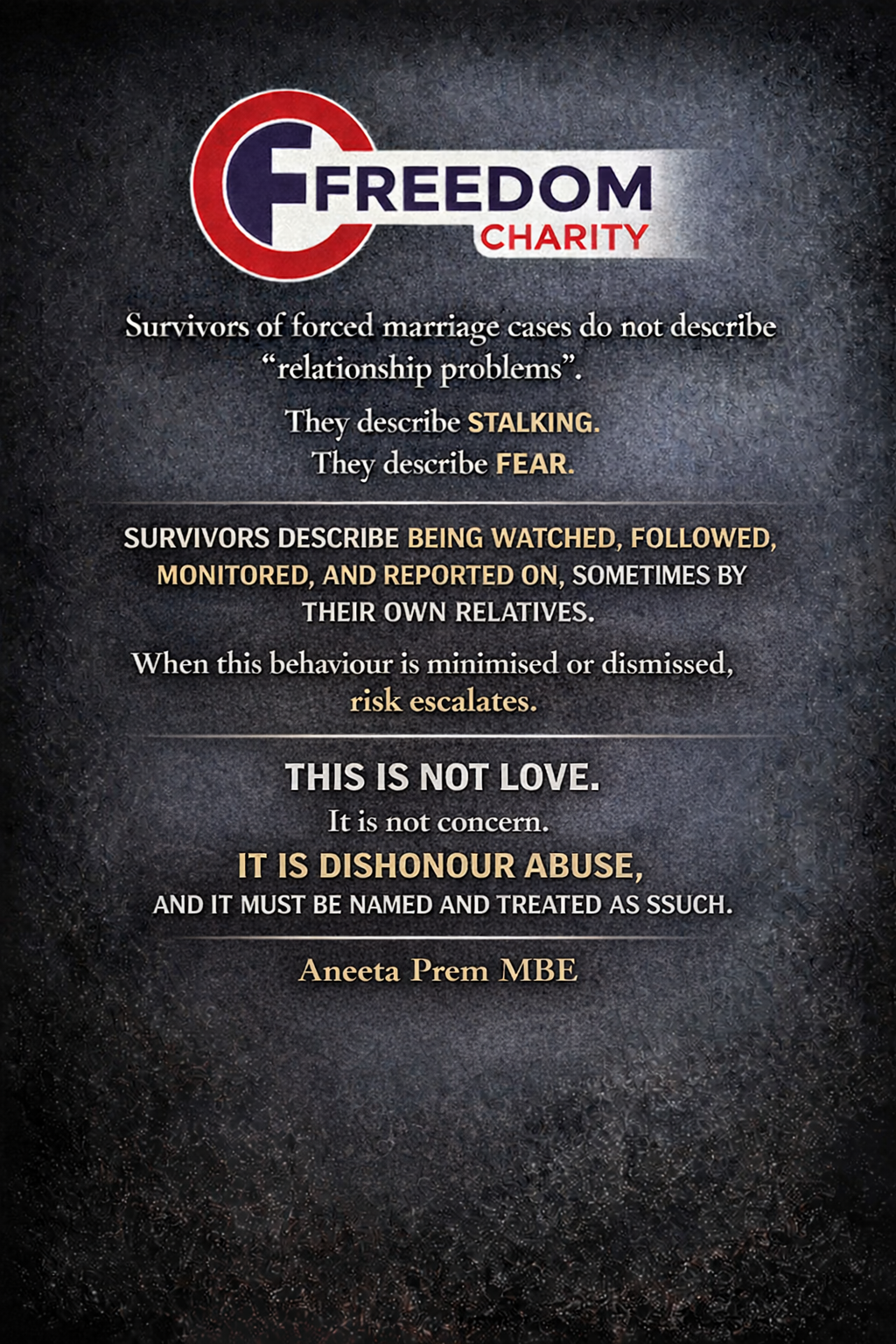
Stalking is often imagined as a stranger outside a house or an ex-partner sending repeated messages. It can look like that. But stalking can also involve relatives, third parties, online accounts and a wider network of people watching, reporting or repeatedly contacting somebody.
That matters in forced-marriage and dishonour-abuse safeguarding, where surveillance may be used to enforce family expectations or punish a person for a relationship, friendship, education or decision that others disapprove of.
The important question is not whether the person doing the watching is a stranger, partner or relative. It is whether there is a repeated course of unwanted conduct and what effect that pattern has on the person being targeted.
What stalking means in England and Wales
Stalking offences sit within the Protection from Harassment Act 1997.
Section 2A covers stalking, while section 4A covers stalking involving fear of violence or serious alarm or distress that has a substantial adverse effect on day-to-day activities.
The legislation gives examples of conduct associated with stalking, including following somebody, contacting or attempting to contact them, publishing material about them, monitoring their use of electronic communications, loitering, interfering with property and watching or spying on them.
The examples are not exhaustive. The law looks at the course of conduct as a whole.
Family members can be part of the pattern
Stalking law is not limited to former intimate partners.
In a family-enforced abuse context, one person may monitor a phone, another may report movements, another may repeatedly contact the victim and another may appear at work, school or a partner’s address.
Each act may look minor when viewed alone. Together they may create a pattern of surveillance, intimidation or control.
This is why safeguarding professionals should record the course of conduct rather than treating every contact as an isolated event.
How stalking can overlap with dishonour abuse
Official agencies use the term “honour-based abuse”. In my own work, I use dishonour abuse because there is no honour in coercion, threats or violence used to enforce family reputation.
Stalking can become one mechanism within that wider pattern.
A person may be watched because relatives suspect a relationship. Their movements may be reported to family members. Social-media accounts may be monitored. Friends may be contacted. Pressure may escalate if the person is thought to be refusing a marriage or making choices considered unacceptable by others.
Heritage or family closeness is not evidence of stalking. The evidence is the behaviour: repeated unwanted monitoring, contact, following, interference or intimidation and its impact.
Stalking Protection Orders
Stalking Protection Orders were introduced in England and Wales in 2020.
Police can apply to a magistrates’ court for an SPO where the statutory conditions are met. A prior conviction is not required. Orders can include restrictions and positive requirements intended to protect a person from stalking risk.
Breach of an SPO is a criminal offence and can carry up to five years’ imprisonment.
SPOs are important because stalking is often an escalating pattern. Protective action should not have to wait for the most serious possible offence.
What the Crime and Policing Act 2026 adds
Part 6 of the Crime and Policing Act 2026 contains new stalking reforms.
They include provisions enabling courts to make Stalking Protection Orders following conviction or acquittal in qualifying circumstances, a statutory framework for multi-agency stalking guidance, and powers for guidance about police disclosure of information where a victim may not know the identity of an online stalker.
Those reforms are now in the Act. But enactment and commencement are not the same thing. Government commencement material makes clear that provisions not already brought into force will commence through regulations.
Anyone relying on a particular new power in a live case should therefore check the current commencement position and current Home Office or police guidance.
What the latest national figures show
The Government’s 2026 stalking factsheet cites Crime Survey for England and Wales estimates for the year ending March 2025: 2.9% of adults aged 16 and over experienced stalking, with women more likely to report stalking than men.
It also records 141,645 police-recorded stalking offences in the year ending September 2025.
The Government expressly warns that police-recorded crime is not a good measure of stalking prevalence. Survey estimates and recorded offences answer different questions and should not be mixed together.
Why “just block them” is not enough
Blocking an account may sometimes help, but it is not a complete safeguarding response.
A persistent stalker may use new accounts, third parties, workplace contact, physical surveillance or other methods. Changing settings can also sometimes alert a person who is monitoring a victim.
Safety advice therefore needs to be individual and proportionate. People should not be told to confront a suspected stalker or make abrupt digital changes if doing so could increase risk.
What professionals should record
Useful records can include:
- dates and times of contact or sightings;
- messages, calls and online accounts used;
- third parties involved;
- changes to work, school, travel or daily routines because of fear;
- threats, property interference or attempts to obtain information;
- links with forced marriage, domestic abuse or family-enforced control; and
- any escalation in frequency, proximity or seriousness.
Good recording helps show the pattern rather than leaving every incident disconnected.
If somebody is at risk
If there is immediate danger in the UK, call 999. If the matter is not an emergency, stalking can be reported to the police through 101 or local reporting routes.
Where forced marriage or family-enforced abuse is also suspected, professionals should follow the current multi-agency forced-marriage and safeguarding guidance and avoid actions that could increase risk, including inappropriate family contact.
Final word
Stalking is not defined by romance, jealousy or the relationship between the people involved.
It is about a repeated pattern of unwanted conduct and the fear, alarm, distress or restriction it creates.
In dishonour-abuse cases, surveillance by relatives or a wider network can be part of the mechanism of control. Recognising that pattern early gives safeguarding systems a better chance of acting before the behaviour escalates.
Care respects autonomy. Surveillance used to control another person does not become care because the watcher is family.
Sources and further reading
- CPS: stalking and harassment guidance
- Protection from Harassment Act 1997
- Home Office: Stalking Protection Orders guidance
- Home Office: Crime and Policing Act 2026 stalking factsheet