





Reviewed and updated 20 August 2026 against current research from Surviving Economic Abuse and the latest National Police Chiefs’ Council domestic-abuse death data.
By Aneeta Prem MBE
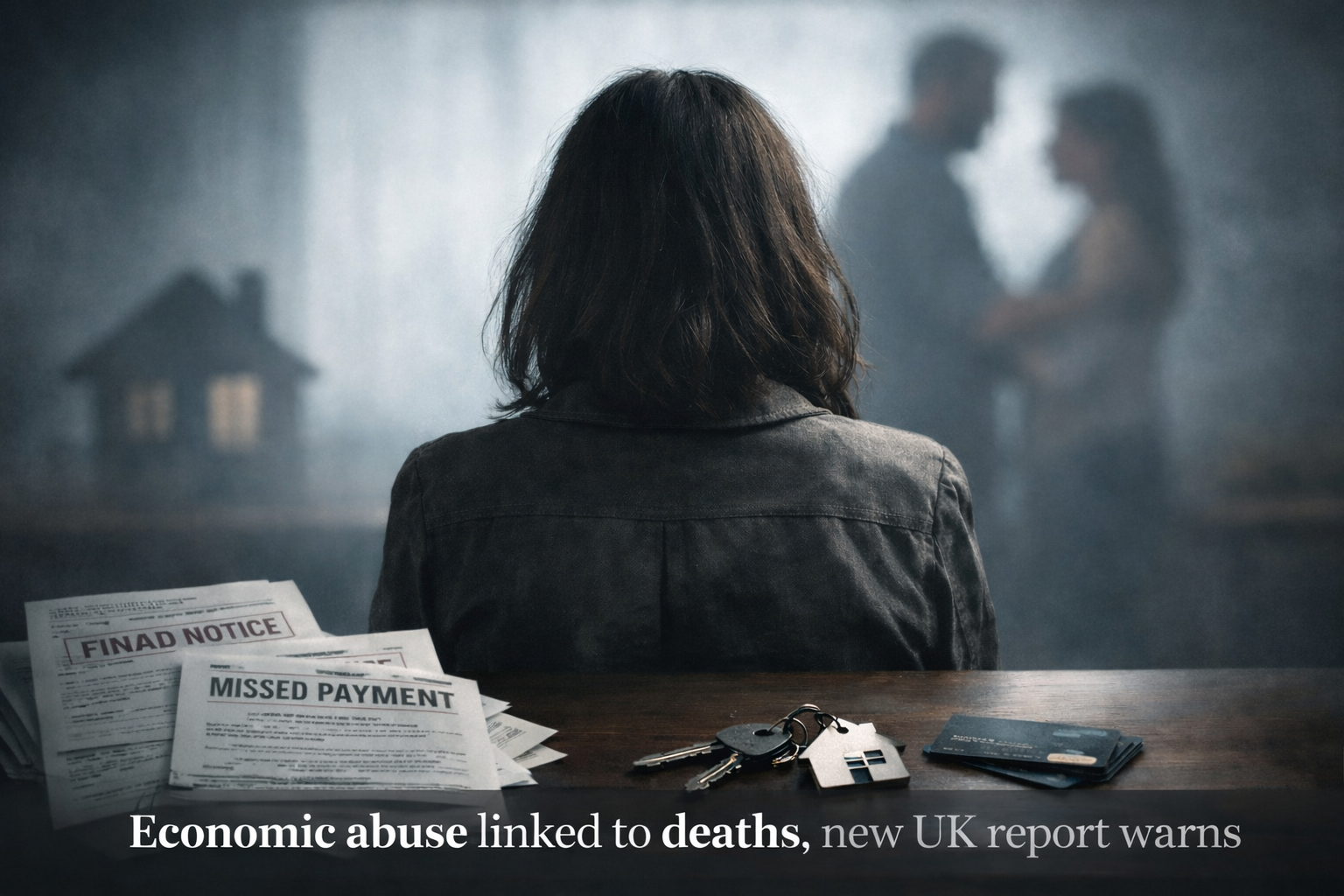
Economic abuse is not simply a money problem. It can be one of the mechanisms that keeps somebody trapped in a dangerous relationship.
Research published by Surviving Economic Abuse in March 2026 examined 454 Domestic Homicide Reviews and found evidence of economic abuse by a current or former intimate partner in 231 reviews — 51%.
Yet fewer than half of the review panels in those cases — 47% — identified the economic abuse themselves.
That gap matters. If economic abuse is being missed even after a death has triggered a formal review, professionals should ask whether financial control is also being missed earlier, while there is still an opportunity to intervene.
What the research actually found
The 454 reviews covered domestic-abuse-related deaths over a period from 2012 to 2024. Surviving Economic Abuse calculated that the 231 deaths involving intimate-partner economic abuse were equivalent to one death every 19 days across that period.
That figure should be described carefully. It is an average derived from the review sample and time period. It is not a prediction that a death occurs on a fixed schedule, and it does not measure the full prevalence of economic abuse.
The researchers also found that 90% of the relevant reviews involved at least one female victim and 90% involved at least one male perpetrator. Victims in reviews featuring intimate-partner economic abuse were younger on average than those in reviews without it.
The central finding is not a slogan. It is that economic restriction, exploitation and sabotage appeared repeatedly within fatal domestic-abuse cases and was often not explicitly recognised by the review process.
What economic abuse can look like
Economic abuse can involve controlling access to money, creating debt in somebody else’s name, preventing or interfering with employment, withholding essentials, taking wages or benefits, damaging credit, controlling property or forcing somebody to account for every purchase.
It can also continue after separation.
The Domestic Abuse Act 2021 explicitly includes economic abuse within the statutory definition of domestic abuse in England and Wales. That legal recognition is important because the behaviour can otherwise be dismissed as a private financial dispute.
The safeguarding question is whether money and resources are being used to restrict another person’s independence, safety or ability to leave.
The latest fatal-abuse data
The national picture has also moved on since this article was first published.
In April 2026, the National Police Chiefs’ Council reported 347 deaths linked to domestic abuse in England and Wales in the year to March 2025. These included 150 suspected suicides following known domestic abuse and 80 intimate-partner homicides.
The NPCC cautions that improved recognition and recording contributed substantially to the increase in recorded deaths. Police practice now requires more systematic checks for a history of domestic abuse at suicides and unexpected deaths.
That is an important reminder: better detection can make recorded numbers rise without proving an equivalent increase in underlying incidence.
Why economic control can increase danger
Leaving an abusive relationship often requires money, housing, transport, documents, access to a phone and the ability to support children.
An abuser who controls those resources can make escape much harder.
That does not mean economic abuse on its own predicts a fatal outcome. Risk assessment must always look at the full pattern, including coercive control, stalking, strangulation, threats, escalation, separation and other known indicators.
But treating economic abuse as irrelevant to physical safety is no longer defensible.
What professionals should ask
When domestic abuse is suspected, practical questions about money can reveal control that a general question about finances may miss:
- Can the person access their own money?
- Can they work or study without interference?
- Has debt been created in their name?
- Can they obtain food, medicine, transport or other essentials independently?
- Does somebody monitor every purchase?
- Are benefits, wages or savings being taken?
- Would lack of money stop them leaving or obtaining legal help?
Those questions should sit alongside, not replace, wider domestic-abuse assessment.
Recognition in law is not enough
Economic abuse is now named in legislation, guidance and specialist research. The harder issue is whether frontline systems identify it consistently.
The Surviving Economic Abuse research suggests they do not.
That is why Domestic Homicide Reviews matter. Their purpose is not simply to describe what happened after somebody died, but to identify learning that may prevent another death.
If a form of coercive control repeatedly appears in the evidence but is not being named by review panels, that is itself a system-learning issue.
Final word
Economic abuse can remove the practical means by which a person protects themselves.
It can make leaving harder, deepen dependence and sit alongside other forms of coercive control and violence.
The evidence does not justify turning every financial disagreement into a safeguarding allegation. It does justify taking patterns of financial restriction, exploitation and sabotage seriously when they are being used to control another person.
Freedom from abuse includes the practical freedom to use money, work, obtain essentials and make decisions without another person using economic power as a weapon.
Sources and further reading
- Surviving Economic Abuse: Hidden Risks, Fatal Consequences
- Domestic Abuse Act 2021, Part 1
- NPCC: domestic-abuse-linked deaths, April 2026
Support
If you are in immediate danger in the UK, call 999. Specialist domestic-abuse services can also help with safety, housing, legal and financial options.