





Reviewed 20 August 2026. This is an authored patient-voice framework, not a validated clinical instrument, diagnostic tool, medical advice or substitute for specialist care.
By Aneeta Prem MBE
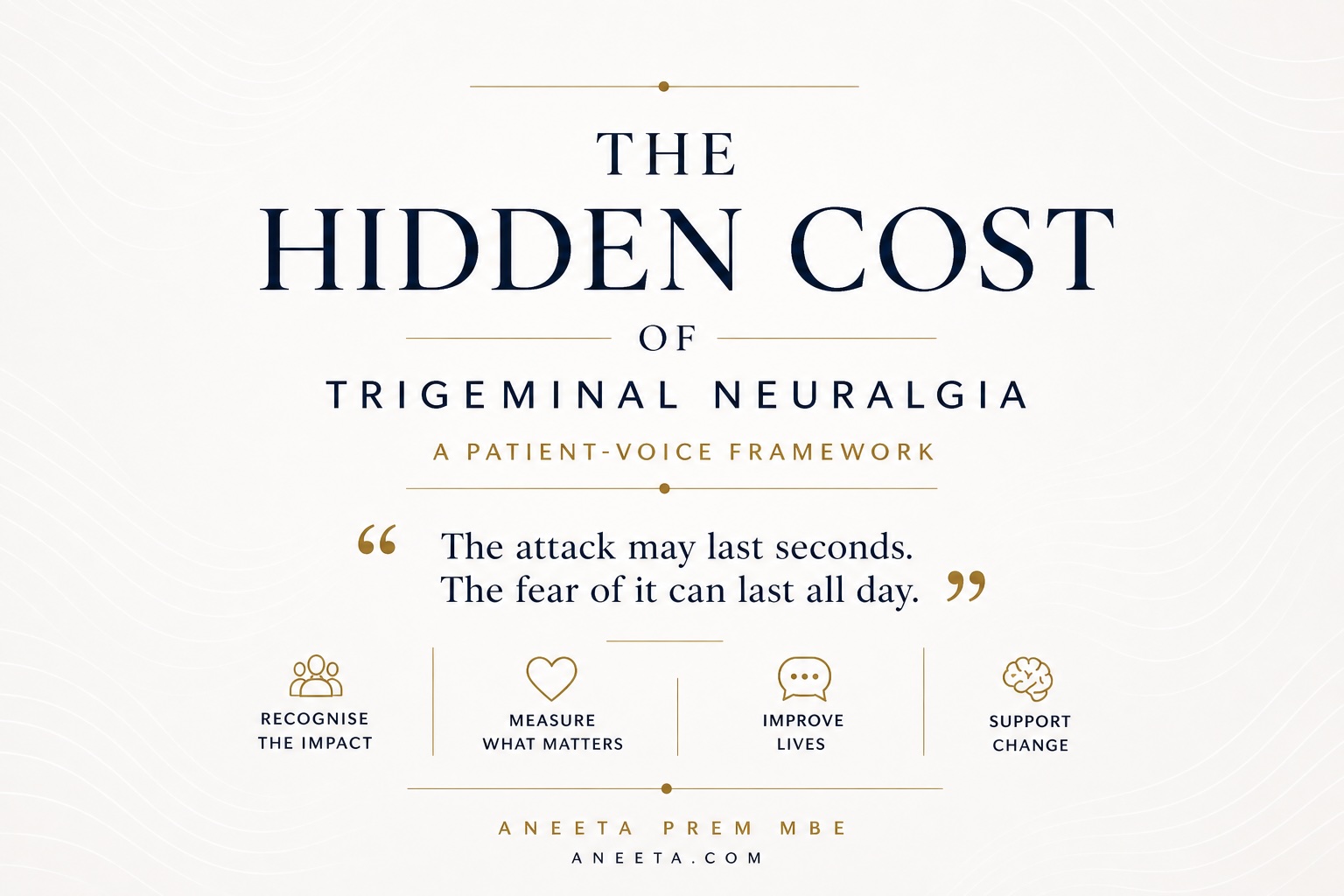
The attack may last seconds. The fear of another attack can shape the rest of the day.
Clinical language is essential for diagnosis and treatment. Patient language helps describe what severe facial pain can take from a person’s life.
The NHS describes trigeminal neuralgia as sudden, severe facial pain, often sharp, shooting or electric-shock-like. Attacks can be brief, but their consequences may extend into eating, speaking, washing, work, relationships, sleep and confidence.
I developed this A to Z as a patient-voice framework: a way of naming emotional, social and quality-of-life experiences that can accompany trigeminal neuralgia and other severe facial pain. It is intended to support conversation, not to diagnose mental-health conditions or measure clinical outcomes.
Why a patient-voice framework can help
Clinicians diagnose and treat. Patients live the consequences. Both forms of knowledge matter, but they answer different questions.
Clinical definitions can describe the location, character and duration of pain. They do not always capture the planning that happens before a meal, the hesitation before a conversation, the fear of cold air, the loss of spontaneity or the effort involved in appearing well.
This framework can be used as a prompt in patient conversations, support groups, awareness work, research discussions and service design. It should complement — never replace — clinical assessment and validated quality-of-life or mental-health measures.
The A to Z of living with severe facial pain
A — Anticipatory anxiety
Fear of another attack can affect plans even when pain is absent. Some people begin to organise meals, journeys, conversations or social events around what might trigger pain.
B — Burden of endurance
Managing severe pain can require effort that is almost invisible to other people. Looking well does not show how much energy is being spent on getting through the day.
C — Confidence
Unpredictable pain can reduce confidence in speaking, eating, travelling, working or committing to plans.
D — Depression and low mood
Long-term pain can affect mood and hope. Persistent low mood, depression or thoughts of self-harm need appropriate professional support; they should never be dismissed as weakness.
E — Emotional isolation
Invisible pain can leave somebody feeling unseen even when they are surrounded by people who care.
F — Fear of triggers
Touch, chewing, talking, washing the face, brushing the teeth or cold air can trigger attacks for some people. Ordinary activities can therefore become associated with fear.
G — Grief for what changed
People may grieve for routines, independence, work, relationships or a sense of self that existed before pain became dominant.
H — Being on guard
After repeated severe attacks, some people describe constantly watching for the next trigger. This is a description of experience, not a diagnosis.
I — Identity
A long-term pain condition can alter how somebody sees themselves and how others see them. Patient care should make room for the person beyond the condition.
J — Justification fatigue
Repeatedly explaining invisible pain can be exhausting. People may feel they have to prove why they cannot eat, speak, travel or attend as expected.
K — Knowledge gaps
Uncertainty about diagnosis, treatment or referral can deepen distress. Clear explanations and realistic information matter.
L — Loneliness
Pain may remove people from shared meals, phone calls, work, friendships and ordinary social routines.
M — Medication burden
Medicines can be helpful, but side effects can also affect daily life. Benefits, risks and tolerability should be discussed with qualified clinicians.
N — Nerve-pain strain
Severe neuropathic pain can place a sustained emotional and practical strain on the person living with it.
O — Overload
When somebody is already coping with pain or fear of pain, normal demands may feel harder to manage. That does not mean every sensory symptom is caused by TN.
P — Pain memories
Previous attacks can influence behaviour between attacks. Some people avoid activities because they remember what happened the last time they tried them.
Q — Quality of life
Eating, speaking, sleep, work, family life, intimacy and independence all belong in conversations about treatment outcomes.
R — Relationship strain
Pain can change plans, communication and closeness. Families may care deeply and still struggle to understand the condition.
S — Sleep
Pain, medication and worry can all affect sleep. Sleep problems have many causes and should be discussed clinically when persistent.
T — Threat and uncertainty
Unpredictability can make daily life feel risky. Knowing that an ordinary action may trigger severe pain can change behaviour.
U — Uncertainty
Not knowing when pain will return, how long a remission may last or what treatment will work can affect planning and confidence.
V — Vulnerability
Severe pain can make people feel dependent or exposed. Care should preserve dignity and autonomy wherever possible.
W — Withdrawal
Some people withdraw from activities because participation has become painful, exhausting or frightening — not because they have stopped caring.
X — eXtreme pain burden
TN is recognised as a condition capable of causing very severe facial pain. It does not need sensational labels to justify serious attention.
Y — Yearning for steadiness
For many patients, the aim is not an abstract score. It is a safer meal, a conversation without fear, a night of sleep or the confidence to make plans again.
Z — Zero assumptions
No framework should assume that every patient experiences the same emotional response. Ask the person what pain has changed for them.
Questions that services can ask
- What has pain stopped this person doing?
- What do they now avoid because of fear of pain?
- How has pain affected eating, sleep, communication, work and relationships?
- What treatment side effects are affecting daily life?
- What support would make everyday life more manageable?
Those questions do not replace diagnosis or clinical outcome measures. They add the part that can be missed when the consultation focuses only on the location of pain.
Support
TNA UK provides information, support and patient community for people affected by trigeminal neuralgia and facial pain.
If somebody is in immediate danger or unable to keep themselves safe, call 999 in the UK. Samaritans can also be contacted free on 116 123 for emotional support.
About the framework
The Aneeta Prem A to Z Framework on Mental Health, Facial Pain and Quality of Life was developed by Aneeta Prem MBE as a patient-voice and discussion framework. It has not been presented as a clinically validated scale, diagnostic instrument or substitute for professional assessment.
Aneeta Prem MBE is Chief Executive of TNA UK and writes about patient experience, diagnosis, facial pain, access to care and the wider impact of living with trigeminal neuralgia.
Sources and further reading
- NHS: trigeminal neuralgia
- NHS: trigeminal neuralgia symptoms
- NICE: neuropathic pain recommendations
- Practical Neurology: trigeminal neuralgia practical guide