




Reviewed and updated 20 August 2026 against current UN Women, UNICEF and UNESCO evidence.
By Aneeta Prem MBE
International Women’s Day 2026 carried a deliberately demanding theme: Rights. Justice. Action. For ALL Women and Girls.
Those words matter because formal rights and lived rights are not the same thing.
UN Women says women worldwide hold only about 64% of the legal rights held by men, and no country has yet closed every legal gap between women and men. The issue is not simply whether equality is written into some laws. It is whether a woman or girl can actually use the law when she needs protection, education, healthcare, property, work, safety or justice.
Rights on paper are not enough
A right that cannot be enforced is fragile.
A girl may technically have a right to education but still be excluded from school. A woman may live in a country with domestic-abuse legislation but be unable to reach safe accommodation, legal help or a responsive police service. A child may be protected by international standards while national law still permits marriage below 18.
That gap between law and reality is one of the central women’s-rights challenges of 2026.
Child marriage remains a global rights failure
UN and UNICEF evidence continues to show that child marriage affects millions of girls and that legal protection remains inconsistent between countries.
The phrase “child marriage” can make the issue sound ceremonial or traditional. The consequences are much more concrete: interrupted education, early pregnancy, economic dependence, restricted choices and increased vulnerability to violence.
In England and Wales, the minimum legal age for marriage and civil partnership is now 18. Internationally, however, the protection is far from universal.
A legal minimum age matters because a child should not have to prove coercion before the law protects them from being caused to marry.
FGM shows the difference between prohibition and recovery
More than 230 million girls and women alive today are estimated by UNICEF to have undergone female genital mutilation.
The global response rightly focuses on prevention. But women already living with the consequences also need healthcare, psychological support, sexual-health care and informed options for treatment.
That is why rights language must include both prevention and survivor care.
A system cannot claim success merely because it condemns the original harm. It must also ask what dignity and recovery look like afterwards.
Afghanistan makes the loss of rights impossible to ignore
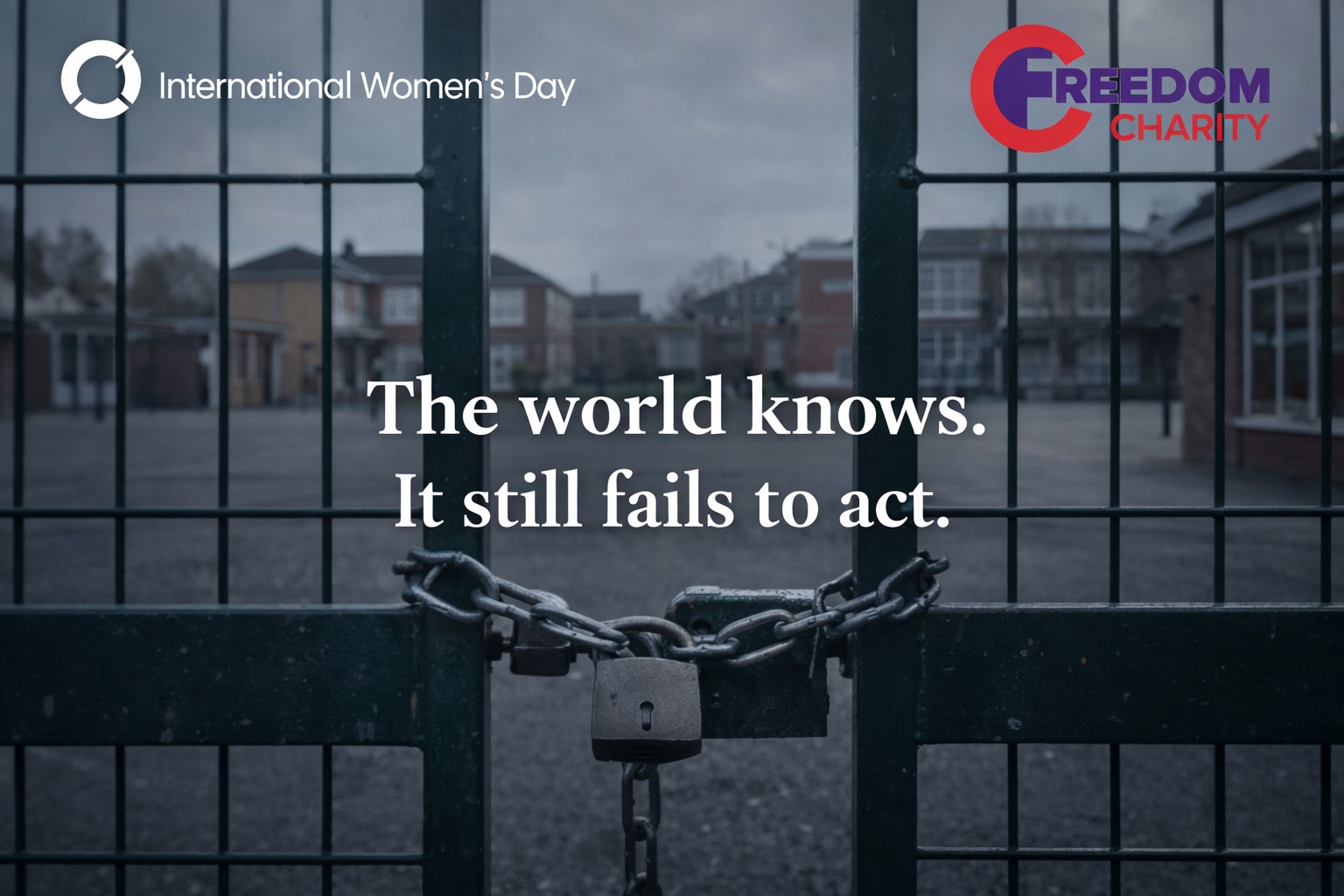
Afghanistan remains the only country in the world where girls and women are formally prohibited from secondary and higher education.
UNESCO and UNICEF reported in January 2026 that 2.2 million adolescent girls had been banned from attending secondary school.
That figure matters because education is not an abstract policy benefit. It shapes health, income, independence, public participation and the ability to make choices about the future.
When education is removed from girls as a class, the loss reaches far beyond the classroom.
Justice means being able to use the law
The second word in the 2026 theme — justice — is easy to celebrate and harder to deliver.
Justice depends on whether somebody can report abuse safely, understand their rights, obtain legal advice, be believed, reach a court, afford representation and receive an effective remedy.
It also depends on whether institutions understand forms of control that do not arrive as a single visible assault.
Forced marriage, FGM, domestic abuse, economic abuse and family-enforced coercion may involve pressure spread across several people and over time. A justice system that waits only for obvious physical violence can miss the pattern until the danger has escalated.
Why I use the term dishonour abuse
Official agencies commonly use “honour-based abuse”. That is the term people will see in policy, statistics and professional guidance.
In my own work, I use dishonour abuse because there is no honour in coercion, threats, forced marriage, FGM or violence used to enforce family reputation.
The language should never place shame on the person being controlled.
At the same time, professionals must understand the official terminology so that safeguarding concerns are recognised within the systems designed to respond to them.
Action means more than awareness
The final word in the 2026 theme is action.
Action can be measured.
It means schools recognising risk before a child disappears from education. It means health professionals knowing when a disclosure triggers safeguarding duties. It means police and courts using protection powers effectively. It means specialist services being funded well enough to respond. It means governments publishing data that allows the public to see whether promises are working.
It also means listening to women and girls without requiring them to carry the whole burden of fixing the system.
What should be different by the next International Women’s Day?
Commemorative days are useful only if they create a standard against which progress can be judged.
By the next International Women’s Day, the questions should be practical:
- Have more girls remained in education?
- Have harmful legal gaps been closed?
- Can victims reach justice faster?
- Are specialist services more accessible?
- Are child-marriage and FGM protections being enforced?
- Are governments publishing evidence of implementation rather than only announcements?
Those questions are harder than a slogan. That is precisely why they matter.
Final word
Women and girls do not need rights praised in principle while protection fails in practice.
They need law that can be used, justice that can be reached and institutions willing to act before harm becomes irreversible.
Rights. Justice. Action. The value of each word depends on whether women and girls can feel the difference in their lives.
Sources and further reading
- UN Women: International Women’s Day 2026
- UNICEF: child marriage data
- UNICEF: global FGM estimates
- UNESCO and UNICEF: girls’ education in Afghanistan