





Reviewed and updated 20 August 2026 against the Children’s Wellbeing and Schools Act 2026 and current Department for Education guidance.
By Aneeta Prem MBE
England’s approach to mobile phones in schools has moved from non-statutory guidance to a statutory national expectation.
The Children’s Wellbeing and Schools Act 2026 received Royal Assent on 29 April 2026. Department for Education guidance on mobile phones became statutory on 29 June 2026. Schools are expected to begin following it from 1 September 2026.
That timetable matters. The guidance is statutory now, but the Department has deliberately allowed schools time to prepare before the September implementation point.
What the law actually does
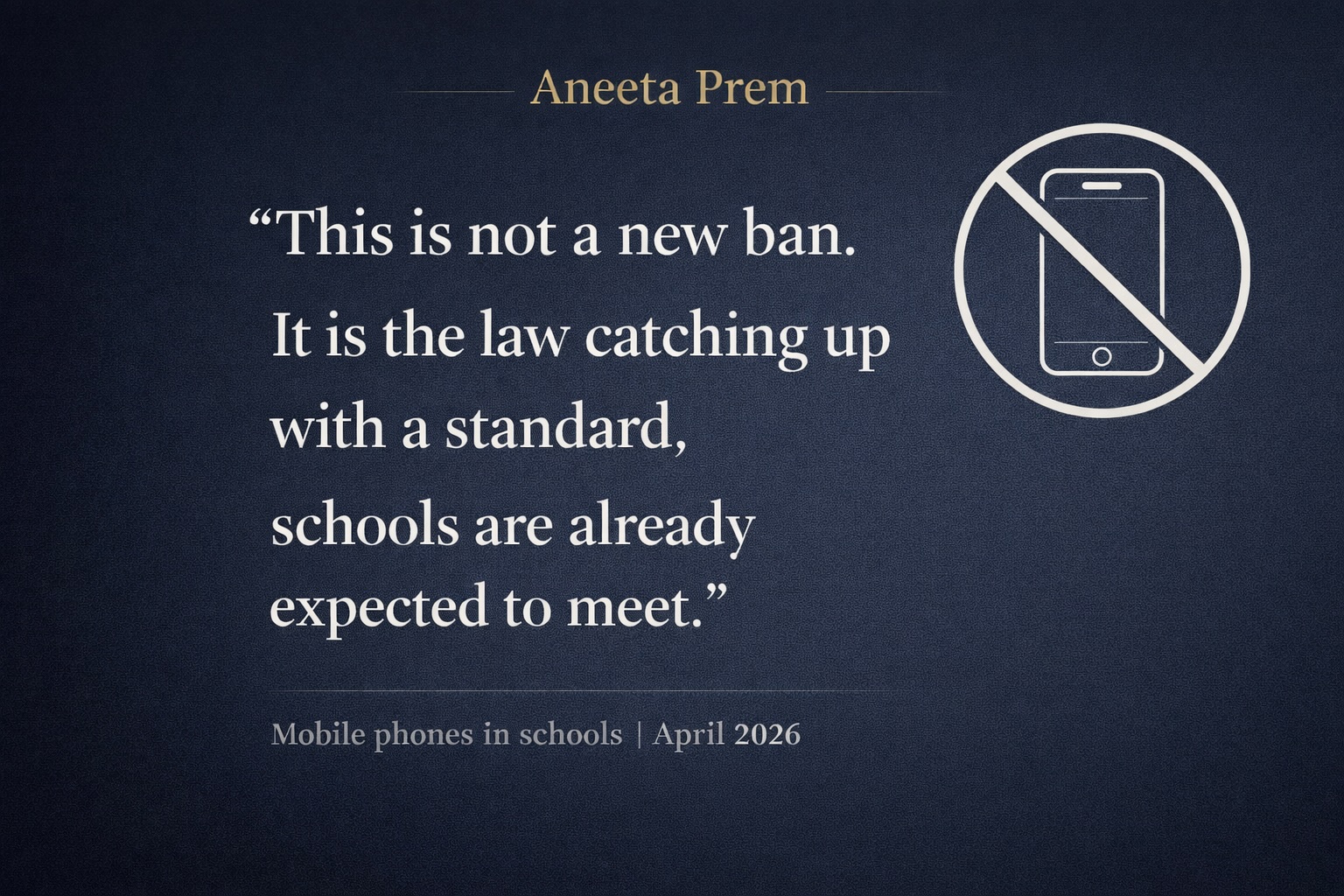
This is not a single criminal-style national ban on pupils possessing phones.
The 2026 Act inserted a new provision into education law requiring the appropriate person for a school in England to have regard to Secretary of State guidance about pupils having and using mobile phones and other personal interactive communication devices during school hours and on school premises.
The statutory guidance says schools should implement a policy under which pupils do not have access to their mobile phones throughout the school day, including lessons, movement between lessons, breaktimes and lunchtime.
School leaders still decide how that policy works in practice and what justified exceptions are needed.
What changes on 1 September 2026
From 1 September, schools are expected to follow the statutory guidance.
“Have regard to” does not mean every school must use an identical storage system or sanction. It does mean the guidance carries legal weight and cannot simply be treated as optional advice.
The Government’s July 2026 response on children’s online lives describes this as a clear legal expectation: schools should follow the guidance unless there is a legally justifiable reason not to.
Ofsted is also expected to check school mobile-phone policy on inspection.
Why schools are being asked to go phone-free
The argument is principally about learning, behaviour and wellbeing.
Phones can interrupt lessons, divide attention and bring social pressure into spaces where children should be able to concentrate. The Department for Education also points to the very high proportion of schools that already restrict phone use, so the policy is not starting from zero.
A clear rule can also make enforcement easier. If pupils know the expectation across the whole school day, staff are not repeatedly renegotiating when a phone may be used.
This is also a safeguarding question
Phones can provide access to useful communication and support. They can also be used for bullying, image-based abuse, coercion, filming, harassment and exposure to harmful content.
A phone-free school day will not remove online harm. Most of a child’s digital life exists beyond the school gates.
But schools can control the environment they provide during the day. Reducing access can create a period in which children are not continuously managing messages, social-media pressure or demands from outside school.
That should be understood as one part of safeguarding, not a complete online-safety strategy.
Exceptions matter
A credible policy cannot ignore individual need.
The statutory guidance recognises adaptations and reasonable adjustments. School leaders may need to consider disability, medical needs, safeguarding arrangements and other circumstances where access to a device or an alternative arrangement is justified.
That is not a weakness in the policy. Proportionate exceptions are part of applying a general rule fairly.
What this does not solve
A school phone policy cannot:
- stop cyberbullying outside school hours;
- prevent every form of AI image abuse or online exploitation;
- replace relationships, sex and health education or wider digital literacy;
- remove the need for filtering, monitoring and safeguarding procedures; or
- replace parental conversations about children’s online lives.
Restriction and education have to work together.
What a workable school policy needs
The strongest approach is usually the clearest:
- a phone-free school day as the default;
- one policy understood by pupils, parents and staff;
- a practical method for storing or disabling access to phones;
- consistent and proportionate sanctions;
- defined exceptions for medical, disability, accessibility or safeguarding needs;
- a process for lost, stolen or urgently needed devices; and
- digital-safety education that continues beyond the ban.
Schools should also be clear about sixth-form pupils. The current guidance gives the example of limiting sixth-form phone use to a common room so younger pupils are not seeing unrestricted use around the site.
Parents need clarity too
Parents often want children to carry a phone for the journey to and from school. A phone-free school day does not necessarily prevent that.
The key distinction is between carrying a device for travel and having access to it during the school day.
Schools should explain where phones are kept, how parents can contact a child urgently and how medical or safeguarding exceptions are handled.
Final word
England has not created one rigid national phone ban. It has created a statutory framework that expects schools to operate phone-free environments and gives the national guidance legal weight.
The dates are important: the guidance became statutory on 29 June 2026, and schools are expected to begin following it from 1 September 2026.
The policy will work best when it is simple, consistent and humane — firm enough to protect learning, but flexible enough to recognise genuine individual need.
Sources and further reading
- Children’s Wellbeing and Schools Act 2026
- Department for Education: statutory guidance on mobile phones in schools
- Government response: Growing up in the online world, July 2026