






By Aneeta Prem, human rights campaigner
In the early hours of 17 November 2025, gunmen forced their way into the Government Girls’ Comprehensive Secondary School in Maga, Kebbi State, in north west Nigeria. They headed straight for the girls’ dormitories. By the time the shooting stopped, 25 schoolgirls had been dragged into the night and the vice principal, Malam Hassan Yakubu Makuku, lay dead after trying to block their way. Another staff member was wounded. Two of the girls later escaped. The rest are still missing as I write. People.com+2AP News+2
This was not an isolated atrocity. It sits in a long, deliberate pattern of Nigeria schoolgirl kidnappings that stretches back more than a decade and now includes boys as well. Since the 2014 Chibok abduction, at least 1,683 schoolchildren have been kidnapped in Nigeria, according to Save the Children. Save the Children UK Many more have been killed or injured on school grounds.
It is no accident that the victims are children, and so often girls. Armed groups are attacking the very idea of a girl in a classroom – a girl with choices, a voice and a future. Or, as Michelle Obama once put it, when girls are educated their countries become stronger and more prosperous. Kaplan International Pathways The gunmen who storm schools in Nigeria understand that. They are trying to turn the clock back.
From my work on forced marriage and FGM, I see the same pattern running through every story. A girl’s body, education and future are treated as someone else’s property. In Nigeria, that violence has gone from homes and backstreets into school dormitories. It is one crisis, not three separate ones.
In Maga, the attackers arrived in the middle of the night, heavily armed. Witnesses say they came on motorbikes and on foot, moved quickly across the compound and opened fire as they broke into the boarding house. AP News+1
The vice principal confronted them and was shot dead. The attackers then forced at least 25 girls from their beds and disappeared towards the forests that straddle Kebbi, Zamfara and Sokoto – the same terrain used again and again to hide abducted children. AP News+1
Local hunters, police and the military have now joined the search. No group has yet claimed responsibility, but officials and analysts point to “bandit” networks – armed groups that have grown rich on ransom, cattle rustling and extortion, and that have repeatedly targeted schools for maximum leverage and publicity. AP News+1
UNICEF has condemned the attack and demanded the girls’ immediate release. It is not the first such statement and, unless something changes, it will not be the last. Facebook+1
To understand Maga, you have to look back.
Chibok, Borno State – April 2014
In 2014, Boko Haram militants stormed the Government Girls Secondary School in Chibok and abducted 276 girls as they slept in their dormitory or sat exams. UNICEF+1 The #BringBackOurGirls campaign made global headlines. A decade on, human rights groups report that around 80 of those girls are still missing, believed to be in captivity. Amnesty International+1
Dapchi, Yobe State – February 2018
Four years later, in Dapchi, 110 girls were taken from the Government Girls’ Science and Technical College. Wikipedia Most were released a month later. One, Leah Sharibu, a Christian teenager who refused to convert to Islam, remains in captivity years on and has become a symbol of both courage and abandonment. Wikipedia+2The Guardian+2
Kankara, Katsina State – December 2020
In Kankara, more than 300 boys were abducted from their boarding school in a single night. Wikipedia+1 They were eventually released after negotiations, but their kidnapping marked a dangerous shift – from ideological attacks by Boko Haram in the north east to mass ransom kidnappings by criminal gangs further west.
Jangebe, Zamfara State – February 2021
In Jangebe, Zamfara, 279 girls aged between 10 and 17 were seized from a Government Girls Science Secondary School. Wikipedia All were later freed, but not before the world saw yet another line of exhausted, terrified girls being marched between politicians and cameras.
Kuriga, Kaduna State – March 2024
In March 2024, gunmen abducted 287 students and a teacher from Kuriga in Kaduna State. The teacher was later reported killed. Some children escaped. Others were released after about two weeks, following intense pressure on the government. UNICEF+2UNICEF+2
Between these headline incidents are dozens of smaller attacks on schools and on children travelling to and from class in states including Niger, Kaduna and Kebbi. Human Rights Watch has warned that ten years after Chibok, Nigerian authorities have still not put in place and sustained the basic safeguards needed to keep children safe at school. Human Rights Watch+1
By August 2023, Save the Children counted at least 1,683 schoolchildren kidnapped in Nigeria since Chibok. Save the Children UK That was before Kuriga in 2024 and Maga in 2025.
Why are schools such frequent targets in Nigeria – and why are girls so often at the centre of these attacks?
There are three overlapping reasons.
First, ransom and power.
Armed groups have discovered that mass kidnappings are highly profitable. SBM Intelligence has documented hundreds of mass abductions in recent years, with billions of naira paid in ransom across Nigeria between 2019 and 2023. Al Jazeera When a gang seizes dozens or hundreds of children, it creates instant leverage over local communities and national leaders.
Second, ideology.
Boko Haram’s very name is widely translated as “Western education is forbidden”. Its leaders have explicitly framed girls’ schooling as a threat to their vision of religious order and gender roles. In practice, that ideology has bled into the wider kidnapping economy. Even groups motivated mainly by money now echo the same contempt for girls’ education in their threats and “warnings” to communities.
Third, impunity and weak protection.
Nigeria endorsed the Safe Schools Declaration and even hosted the Fourth International Conference on Safe Schools in Abuja in 2021. protectingeducation.org+2Wikipedia+2 Yet implementation on the ground has been patchy. UNICEF estimated in 2021 that at least one million Nigerian children were too afraid to return to school because of insecurity, following more than 20 attacks on schools that year alone. UNICEF+2Voice of America+2
Fences, alarm systems and trained guards are still missing from many rural schools. In some cases, authorities have responded not by making schools safer, but by closing them indefinitely. That may remove an immediate target, but it also quietly hands victory to the men with guns.
When I read the details of these attacks, I do not see separate issues. I see one system of abuse.
In Nigeria, 44 per cent of women aged 20 to 24 were married before the age of 18 and 18 per cent before 15, according to recent UNICEF-supported research. That amounts to more than 24 million child brides – the third highest absolute number in the world. UNICEF+2Open Access Repository+2
Nigeria is also home to an estimated 19.9 million women and girls who have undergone female genital mutilation. They represent around ten per cent of all FGM survivors globally. United Nations Population Fund+1
These are not “cultural practices” sitting politely in a separate box from armed violence. They are part of the same continuum.
The language used to justify all of this – whether in a village compound or at the gates of a school – is the language of so-called honour. I call it dishonour abuse. It is the systematic use of honour, shame, religion and reputation to excuse the inexcusable.
The geography changes. In my own work in the UK, I have seen girls taken out of school for forced marriage, or flown abroad to be cut. In northern Nigeria, the abuse may come with an assault rifle and a motorbike. But the heartbeat of the crime is the same: a belief that a girl’s body, choices and future belong to other people.
The Nigerian government has not ignored the problem on paper. It has:
Yet the lived reality in places like Maga, Kuriga and Chibok remains brutally simple. Parents still weigh the value of a daughter’s education against the risk of never seeing her again. Children still go to bed wondering whether armed men will come that night. Headteachers still look at broken fences and know that promises in Abuja have not reached their gates.
If we treat Maga as just another sad headline, we will see the same story again and again. Nigeria, and the international community, need to treat this as one linked emergency.
1. Treat school attacks, child marriage and FGM as one crisis of girls’ rights
These are not separate “issues” for different departments and donors. They are one system of dishounour abuse. Laws and policies on education, forced marriage and FGM must be joined up and enforced together, with clear lines of accountability.
2. Put real protection around schools – not just on paper
Every high-risk school needs practical, visible safeguards: secure perimeters, early warning systems, trained security staff, safe routes to school and rehearsed evacuation plans. Communities must be properly consulted so that protection is trusted, not resented. The Safe Schools Declaration was a promise. Now it has to become a budget line.
3. Break the ransom economy
Quiet ransom payments may save individual children, but they fund the next kidnapping. Nigeria needs a clear, public policy on ransom, coordinated with neighbours and backed by targeted financial measures against the networks profiting from abduction.
4. Invest in girls’ education as security policy
Educating girls is not a “soft” add-on. It is one of the strongest tools we have against extremism, poverty and instability. UNICEF has already warned that millions of Nigerian children are either out of school or afraid to return because of violence. UNICEF+2UNICEF+2 Getting them safely back into classrooms is as important as any military operation.
5. International pressure with local leadership
Nigeria is not alone. Governments, multilateral bodies and donors should treat the pattern of Nigeria schoolgirl kidnappings as a test of their commitment to girls’ rights. But the solutions must be led by Nigerian communities, educators, faith leaders and survivors – the people who will still be there when the cameras move on.
Somewhere in the forests of north west Nigeria tonight, a girl from Maga is trying to make sense of what has happened to her. She may hear gunfire. She may hear men arguing over her fate. She may be clinging to another girl she has just met in captivity.
She is not an isolated victim. She is part of the same story as a Chibok girl who never came home, a Dapchi girl who refused to renounce her faith, a child bride whose wedding ended her schooling and a baby held down to be cut.
Until we are prepared to name this as one system of dishounour abuse, and confront it with the same seriousness we bring to terrorism and organised crime, we will go on losing our daughters – in Nigeria, in the UK and across the world.
The question, for all of us, is very simple: how many more stolen schoolgirls will it take before we mean it when we say “never again”?

FGM prevention matters, but survivor care must not be the unfinished part of UK policy. Aneeta Prem calls for a clear NHS pathway, specialist counselling, trained professionals and research into reconstructive surgery.
Many children are not choosing the best place to spend their time. They are choosing the safest unsafe place available.
Dishonour Abuse is abuse, coercion or violence justified through claims of family reputation, shame or so-called honour. I use the term because “honour-based abuse” repeats the perpetrator’s excuse, while Dishonour Abuse names the conduct and places responsibility where it belongs: with the person causing harm, not the victim, child or survivor.

The murder of Henry Nowak raises difficult questions about policing, evidence and the duty to preserve life
The death of Twisha Sharma has reopened a global question about dowry abuse, coercive control, family reputation and why women are still judged by what their families can provide.
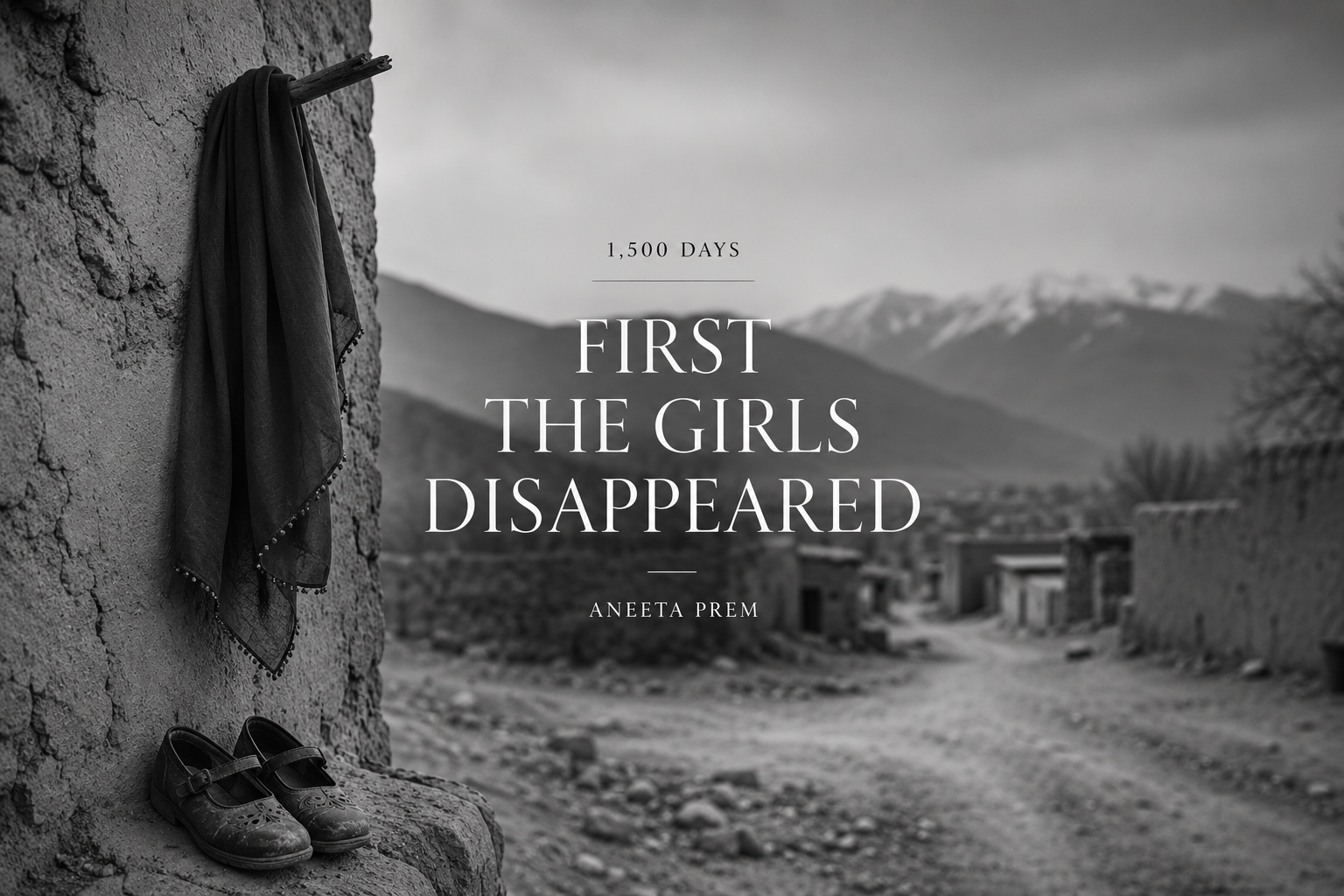
Afghanistan's child marriage is worsening as hunger, aid cuts and Taliban family law place girls at risk. Aneeta Prem writes on why silence is not consent.