




By Aneeta Prem MBE
I did not write my books because I wanted children to become experts in safeguarding terminology.
I wrote them because children need to recognise when something is wrong.
There is an enormous difference between those two things.
Adults talk about forced marriage, coercive control, female genital mutilation, consent and safeguarding pathways.
A child may simply think: My friend went away and did not come back. Everyone says I have to do this. I have been told not to tell anyone. Something about this feels wrong.
Stories can reach that space.
Why begin with fiction?
Guidance is essential. So are policies, professional training and the law.
But a child does not experience life as a policy document.
They experience friendships, families, secrets, school, arguments, holidays, embarrassment, loyalty and fear.
That is why I chose fiction.
A reader can walk alongside a character before being asked to understand a difficult concept. They can notice that something has changed. They can worry about somebody. They can ask themselves what they would do.
And sometimes they can recognise something in a fictional story that they were not yet ready to recognise in their own life.
Why I wrote But It’s Not Fair
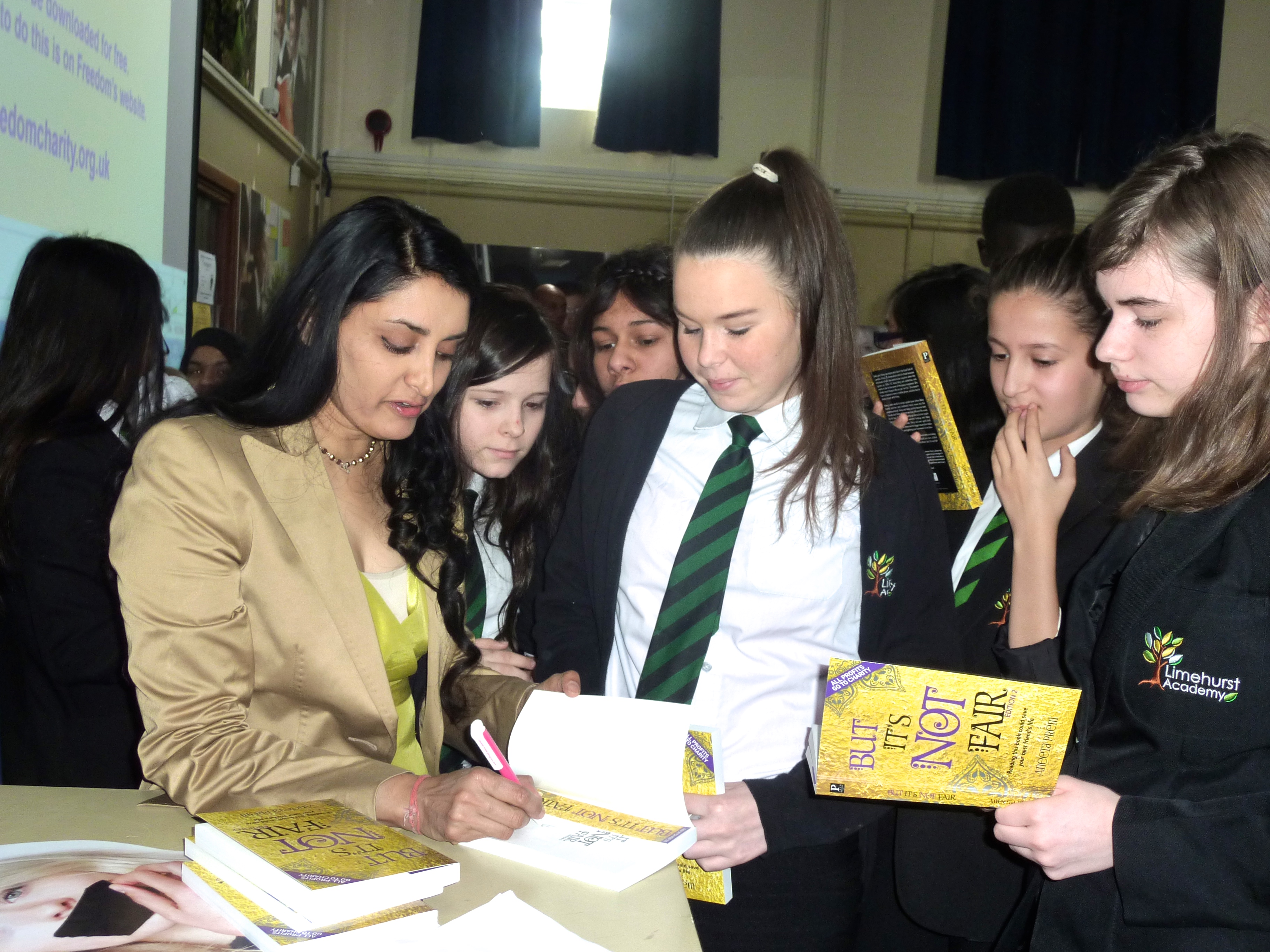
But It’s Not Fair deals with forced marriage through friendship and ordinary family life.
I wanted the subject to be understandable without making the book feel like a lecture.
Forced marriage is often discussed as if everybody at risk already knows the correct language for what is happening to them. Many do not.
A young person can know that they do not want something without understanding that the pressure surrounding them has a legal or safeguarding name.
The story gives readers somewhere to begin.
What does choice mean? When does family expectation become coercion? What would you do if you were worried about a friend? Which adult could you tell?
Those questions can matter long before a child is ready to make a disclosure.
The UK Government has hosted But It’s Not Fair as a forced-marriage educational resource. The purpose was always larger than selling a novel.
Why I later wrote Cut Flowers
FGM presents a different educational challenge.
When a girl is subjected to FGM, it is child abuse, but teaching the subject badly can itself cause harm.
The subject can become graphic very quickly. Children may be sitting in a classroom with personal or family experience that the teacher does not know about. Others may come from communities unfairly stereotyped whenever FGM is discussed.
I wanted Cut Flowers to make the safeguarding principle understandable without turning children’s bodies into shock material.
The story therefore begins with children, friendships, family and ordinary life. It gives readers time to care about the characters. Only then does the safeguarding issue become clearer.
That is deliberate.
The objective is not fear. It is recognition, empathy and knowing that an adult can be told.
The books and PSHE education
There has sometimes been confusion about this, so I want the position to be precise.
The novels themselves are not PSHE accredited.
Freedom Charity developed separate educational resources, and the PSHE Association worked with Freedom Charity on two lesson packs covering forced marriage and FGM for Key Stages 3 and 4.
The PSHE Association states that the novels can be used alongside those lessons.
That distinction is important.
A novel is a story. A structured lesson has different educational and safeguarding requirements. The two can support one another without pretending they are the same thing.
More than 100,000 books
Freedom Charity reports that it has donated more than 100,000 copies of But It’s Not Fair and Cut Flowers to schools, young people and safeguarding settings.
That is a number I am proud of, but numbers alone are not the reason the work matters.
The real question is what happens when a book reaches a reader.
Does a child understand choice differently? Does a teacher find a safer way into a difficult conversation? Does somebody recognise that what is happening to their friend should be shared with a trusted adult?
A book cannot protect a child by itself. But information can change what somebody recognises. Recognition can change what somebody says. And what somebody says can change what happens next.
Why simple language matters to me
Safeguarding language can become strangely complicated.
The people who most need information are often expected to understand vocabulary created by professionals for other professionals.
Children should not have to decode adult language before they can understand their own rights.
Simple does not mean childish. It means understandable.
What fiction can do that a factsheet cannot
A factsheet can tell you that forced marriage is illegal.
A story can make you care about the person who is frightened to say no.
A lesson can explain that FGM is abuse.
A story can help a reader understand why a child might still love the family members who are putting them at risk.
That complexity matters.
Safeguarding becomes dangerous when we imagine that victims behave in simple ways. People can be frightened and loyal, angry and protective, desperate to escape and terrified of losing their family.
Children particularly should never be blamed for those contradictions.
Books should open conversations, not close them
I would never want a teacher to finish one of my books and think the safeguarding work was done.
The opposite should happen.
A book should open the door to better questions: What does consent mean? Can you change your mind? Who can you tell? What happens if the person causing harm is someone you love? Where can you get help safely?
Those conversations need trained adults, good safeguarding procedures and reliable information around them.
Why I still believe in books
Young people’s lives are increasingly digital. So are many forms of abuse.
But there is still something powerful about giving somebody a story they can hold, return to privately and understand at their own pace.
A child may not raise their hand during a lesson. They may read a chapter at home. They may come back to a sentence. They may remember it months later.
Sometimes the first step towards asking for help is simply finding the words for what is happening.